Friday, May 26, 2006

Random Friday: Memorial Weekend Edition

[Wherein our hero posts a collection of queries, ponderings, and dubious trivia to clear his mind for the long weekend ahead. A happy holiday to you all, and remember: a good BBQ is a safe BBQ.]

Benjamin Franklin's suggestion for the official bird of the new United States was the wild turkey. One of the great man's few missteps, it led to an unsuccessful bid at suicide-by-electrified-kite.

McDonald's
is running a new commercial in which two coworkers are sharing lunch. One warns the other--who is eating a chicken sandwich from the Arches--that if he keeps eating chicken sandwiches he will turn into a chicken. In one of the darkest turns ever witnessed in a fast-food spot not featuring the Burger King, a Kafkaesque metamorphosis takes place in subsequent scenes as the man, indeed, begins to resemble a chicken. (In one shot, there is a fox in his hallway eyeing him with hungry fox-eyes.) Not shown are the scenes portraying the transformation of the burger-munching co-worker into an inambulatory mound of unprocessed soy filler, torn cowhide, minced hoofparts, and rat excreta.

With bleary, dead, rueful eyes.

Foxes are renowned throughout the animal kingdom for possessing the largest vocabularies of any four-legged beast.

The polar bear is a close second, though their habit of devouring rapt listeners has led to the species' largely oral history becoming shrouded in mystery and speculation.

While most hippopotami never learn to read or write, they are acutely aware that their name derives from the Greek (via Latin) for "river horse." Neither the hippos nor this observer are quite sure what the Greeks were thinking there.

Seriously, though, what's up with the Yeti? You just don't hear from 'em as much as you used to.

Upon his abdication of the English throne, Edward VIII embarked on a brief but lucrative alt-porn career under the pseudonym "Li'l Eddie, Lord Fucking-Hand." No copies of his work survived a direct hit during the Blitz, though Hitler, ironically, was rumored to have been a fan. The loss of the negatives filled the Nazi leader with his only regrets of the Second World War, and led to a debilitating period of self-doubt fueled by schnapps and tearful autoerotic asphyxiation.

Most common euphemism for masturbation [American English]: "spanking the monkey."

Least common euphemism for same: "tap-dancing with Ernie Borgnine."

Number of times it looks like Borgnine might make out with William Holden in Sam Peckinpah's The Wild Bunch: 7.

Number of times he actually does: 1. The scene was deleted from the original theatrical release, though sources hail that long-lost clip as a brilliant (if whiskey-soaked) deconstruction of Wild West machismo that paved the way for future gay-in-the-saddle epics like Brokeback Mountain.

Is Borat [at right] wearing a man-thong stretched to the limits of Lycra, or a woman's bathing suit sold by hateful French shopkeepers?

Either way, Borat, nice shoes.

Thursday, May 25, 2006

Soul-Sucking Mediocrity Reaches New Heights

During its fifth season, I managed to catch a collected twenty-odd minutes of "American Idol." And, unsurprisingly, I feel in need of a long shower and perhaps some creepy-albino-monk self-flagellation as penance. Fifteen of those minutes were during last night's season finale, a cavalcade of truly incomprehensible D-list cameos and unforgivably overwrought suspense-mongering on the part of the show's hosts. In the end, it appears more teenage girls with cell phones wished Taylor Hicks were their grandfather than wanted to be Katharine McPhee. The zillion people watching the events unfold live (as we were ceaselessly reminded by the elfin Ryan Seacrest, as if it mattered?) were treated to McPhee performing a duet with Meat Loaf, and to eventual Idol Hicks leading a well-preserved Dionne Warwick around the stage during a not-exactly-all-star rendition of "That's What Friends Are For." The girls and guys evicted from the beach house (different show?) during the past few months returned to show us their pop-medley skills, and 5-watt luminaries like Tori Spelling and a teary David Hasselhoff beamed from the audience during random, irrelevant cutaways from the musical irrelevance unfolding onstage.

Oh, and apparently Prince showed up to cash in the last of the goodwill I was holding for him. I missed that part of the evening's festivities, but I've spoken with his people (all of them equally tiny and well-coiffed, like there's a factory somewhere) and we reached an agreement. I get to keep my copies of 1999 and Purple Rain for all purposes not karaoke, and he never shows up on any jukebox within 500 yards playing anything recorded after the Batman soundtrack. The "Diamonds and Pearls" video is still being contested.

And these were the highlights, mind you. The rest of the show consisted of getting in some final jabs at the most interesting (in the Chinese sense of the word) auditions from the season's first half. Seacrest awarded a handful of horribly misguided kids for publicly butchering the work of the world's most mediocre pop stylists. These segments were introduced with the revelation that "AI" has been overlooked at every TV awards show during its run (thank you, Emmy), even though more people voted during Tuesday night's final showdown than have voted for any American president, ever. Not coincidentally, the latter observation was also the hook for the recent film satire American Dreamz, which I didn't see (but kind of wanted to) because that introduction was simply too damned depressing.

To make a long story short, I just don't get it. Sure, every season is one prolonged exercise in test marketing and product packaging, and there's a long list of manufactured pop acts whose successes were just as calculated as any Idol's. But the irrepressible, stomach-turning earnestness with which these kids (and Hicks) belt out the tiredest, schlockiest, most meaningless pop drivel is enough to drive any conscious observer absolutely fucking batty. Most of the execrable tunes to which the show's assorted performers time their histrionics and vocal flourishes would be cause enough for any member of the target demographic to change the radio station. Even with that fact in mind, however, the kids evidently love hearing dutifully observed covers performed by nobodies backed by the obligatory pop orchestra and gospel choir. I mean, "(I've Had) The Time of My Life?" How anything so predictable and yet so utterly left-field and dated can make the teenyboppers scream is a mystery to me. If you've got an explanation, I invite you to leave a comment at the end of this post.

I know we need our distractions in this frightening modern age, a moment defined by foreign wars predicated upon lies told by shadowy, duplicitous powers-that-be. It's not that I don't understand the popularity of contest programming, which is as old as television. And I get the appeal of witnessing talent plucked from obscurity, an undeniably American dream that drives countless youngsters to seek fame and fortune on the silver screen and the 45. But for my part, hearing Hicks shout a victorious "Soul Patrol!" after being crowned was puzzlingly embarrassing, and not only because I have no idea what the man was talking about. Based on what I saw, I'm not sure where to find the "soul" in his generic performances, and the fact that such a cheesy catchphrase could drive the proceedings filled me with cringing embarrassment, not entirely unwarranted, for everyone involved. Oh, and I'll have to boil my culture-snob eyeballs in bleach to rid them of the slo-mo footage of Hicks and Seacrest writhing on their backs like upended turtles during a gratuitous end-of-show montage. While conducting these necessary ablutions, I'll probably turn on some real pop idols singing their oddest works, like "Maxwell's Silver Hammer" and "Rocky Raccoon," just so I can remind myself that unpredictability and unfathomable, universal popularity can coexist. You can have your Idols, America. I'll stick with The Beatles.

Monday, May 22, 2006

Disco Vanilla Trades In Her 8-Tracks

So there was this Pepsi (or was it Coke?) commercial a while back that featured two trucks, one from each competing sugarwater purveyor, driving alongside each other down the road. At a stoplight one driver flips a switch, shows the other what kind of system he has thumpin' in the rear of his freight-haulin' ride. A moment passes, then the other driver flips his switch. His truck's side panels open to reveal not a truck full of soda products as one would expect, but many stacks of concert-gauge speakers running heavy on the bass end. The sound from the latter truck dwarfs that of the first, and then the whole second rig starts bouncing on hydraulics. Slogans run in the foreground thereafter, proclaiming the latter pop company's vanilla cola to be less "vanilla" than their competitor's--a strange tactic, given that they're selling, after all, vanilla cola.

Now, I'm fully aware that I might be a year or three late with this somewhat reductive analysis of the Vanilla phenomenon. I even had a professor last semester who asked his class if we weren't responding to Henry James' "The Turn of the Screw" because it was too, well, "vanilla." If that's not sure enough a sign that a pop-culture reference has jumped the shark (as the very term "jumping the shark" did about two weeks after the website reared its cyberhead), I'm not sure what is. But hear me out, people, because there have been Interesting New Developments in Vanilla.

Such a proclamation may seem a contradiction-in-terms, but let's look at the evidence. After that initial product introduction (wasn't it a Super Bowl commercial?) there have been a slew of newer variations on the Vanilla theme. There are now cherry-vanilla carbonated beverages, and diet-cherry-vanilla, and raspberry-vanilla-crème (not cream, mind you, but crème--how fancy and urbane!). No less a pitchman than Emeril Fucking Lagasse has shown up shouting "BAM!" from the mountaintops as he sings the praises of Crest Vanilla Mint Whitening Expressions Toothpaste. And where would Vanilla be without her kinda skanky, semi-retired, tarted-up whore of a second cousin, French Vanilla?

(On that note, what is French Vanilla, anyway? Why is it more beige than white--is it egg or something? What makes it "French?" Are there little French kids in an ice-cream sweatshop (?) somewhere doing something more interesting than Breyer's original, plain ol', see-those-vanilla-bean-shavings-that-means-it's-real-vanilla vanilla ice cream? Ahem. I digress.)

The thinking behind the new usage of "Vanilla" is quite obviously racial in overtone, with undercurrents of class instability and a lingering palate of white guilt on the finish. The marketers would have you believe Vanilla is whitebread, WASP, Middle-America, Plain Jane. Vanilla is all "Ahoy, polloi," sporting topsiders and linen pants at the yacht club's cocktail hour. Vanilla has lawn jockeys in the front yard ever since the subdivision council outlawed pink plastic flamingoes, and it doesn't see anything wrong with that. Its darker counterpart in the Neapolitan scheme-of-things (disregarding Strawberry, which is Switzerland in this debate), Chocolate, is the new new thing, the yin to vanilla's yang, the hot new hip-hop shit for the 2K6, even though it's been the same old-school Chocolate for ages untold. Vanilla, it seems, is too old to even be old-school. It's the sockhopper at the Wu-Tang show, it's the moustachioed cops who crash the house party and actually inventory the confiscated weed. Vanilla is the bowtied guys in the Beastie Boys' video who offer soda and pie to all the partygoers who never fought for their right.

To paaaar-tay.

So why, then, does Vanilla seem to be making a comeback in spite of all the aspersions cast her way? Granted: she gets all dressed up in the newest rags, and she's had some surgery to correct both the overbite and the saggy neck, but isn't New Vanilla in the miniskirt and CFMP's just the same old hag with an Extreme Makeover? Why is she worth the bother of Vanilla Mint, Vanilla Crème, Vanilla Raspberry Cherry Swirl Delite? Is there something about Vanilla worth saving?

Apparently the answer is a resounding "YES," at least if you're listening to the marketers who bring the old girl around even while they talk nasty about her to their friends. Sure, New Vanilla's an easy lay, but it hasn't always been that way. She's suddenly willing to try different things, and you might even get her in a three-way with your buddies Minty and Razz (you might even take her Cherry!). It appears that Granny Van is actually hipper than you would think, and the advertising dollars are there to make sure you know it. Maybe Vanilla is the new Chocolate, which--for all its hipness-by-omission, at least in terms of the Vanilla discussion--hasn't seen much in the way of experimentation since the Andes Mint and Cookie Dough ice cream. Not that it's needed any work, mind you.

(But speaking of, doesn't "Chocolate Chip" sound like the nickname you gave your douchebag cousin who played Young M.C. while trying to gouge you for shitty weed when you snuck away from the aforementioned yacht club soiree? Wasn't he just one dirty little chip of wackness in a huge fucking tub of Vanilla?)

It bears noting here that most of New Vanilla's work is hardly worth writing home about, and that's not only because of all the kinky shit she's getting into. Like any good relationship, she's easy to fuck up when you're too busy focusing on other things. So much attention is paid to the dressing-up that somebody seems to have forgotten what Vanilla tasted like in the first place. Strawberry and Chocolate seem to have survived just fine, even when you consider the execrable examples to which they lend their names. It's strange, really, how the simplest experiences are those most easily fouled-up and watered-down. But back to Vanilla. Emeril's much-BAMmed-about toothpaste, for instance, tastes like somebody spat a full swig of Scope mouthwash on a lousy off-brand sundae. Vanilla Coke and Vanilla Pepsi taste about the same (regardless of the creative advertising and dueling cola-hoopties), which is to say that they're nowhere near as good as a fountain soda of either brand with a shot or two of real vanilla syrup. And as for whatever Dr. Pepper thinks he's doing with Vanilla and every berry and cherry hanging from the tree, my prayers are with his patients during this time of misguided distraction.

In the end, I guess there's only one thing we all need to remember: no matter what the corporations who sell us our Things try to throw our way, the best New Shit is almost always the Old Shit. New Vanilla will get busted eventually for working the wrong corner, either by the cops or by some newer, flashier flavor with a razorblade under her tongue and some turf to claim. Old Vanilla will always be right there for us, waiting beneath the cap of an ice-cold IBC Cream Soda. She was born in 1919 and she's had her fair share of bumps in the road, but she's still one of the finest Vanillas this impartial observer has ever enjoyed. Wrinkles and all.

Monday, May 08, 2006

Loose Associations on a Theme

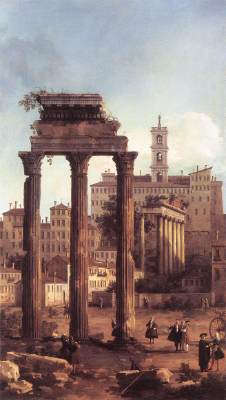
I told Murray that Albert Speer wanted to build structures that would decay gloriously, impressively, like Roman ruins. No rusty hulks or gnarled steel slums. He knew that Hitler would be in favor of anything that might astonish posterity. He did a drawing of a Reich structure that was to be built of special materials, allowing it to crumble romantically--a drawing of fallen walls, half columns furled in wisteria. The ruin is built into the creation, I said, which shows a certain nostalgia behind the power principle, or a tendency to organize the longings of future generations.

Murray said, "I don't trust anybody's nostalgia but my own. Nostalgia is a product of dissatisfaction and rage. It's a settling of grievances between the present and the past. The more powerful the nostalgia, the closer you come to violence. War is the form nostalgia takes when men are hard-pressed to say something good about their country."


--From White Noise, by Don DeLillo

The Alamo, 1999

It seems like just a little old building, and I guess that's all it was. Is. For some reason I expect John Wayne and a coonskin cap, maybe Jim Bowie or Sam Houston as Disney animatronics telling us about the history of the Little Church That Didn't. For a famous last stand it seems oddly placed near the center of downtown San Antonio, close to a Riverwalk I remember from a strange mid-80's Dabney Coleman flick called Cloak & Dagger. We smoke a bowl in the car and have massive cheeseburgers at a chain restaurant featuring a full side of beef hanging in a windowed butchery at the entrance. Once finished with our half-pounders we get back on the road, back to New Orleans, passing along the way a pickup truck loaded with random wooden frames and cushioned furniture. A Tex-Mex father and son grin and wave at us from the loveseat situated cabside in the truck's bed. The father's longish hair blows down on his forehead before he sweeps it back, an effort in vain riding backwards at 80 mph, as he sips intermittently from a paper bag.

Wrigley Field, 1992

The moms bro sis and I are sitting on the third-base line, watching Ryne Sandberg and the Cubs beat the Astros. My sister claims Sandberg as her favorite player, but given that she's a girl and he's one of my own favorites, I assume H. is just trying to keep up with her brothers. It's my fifth or sixth Major League game, the first that doesn't feature the Cincinnati Reds playing at Riverfront. I can smell the Old Style steaming off the skin of the men in front of us, sick-sweet and maybe a false memory. The famous ivy on the outfield wall is too far away to bear any significant odor, but it looks like it smells green, like fresh money or the hide of a lime rhino. My brother and I try to get into the outfield bleachers late in the game, on an ivy-smelling sensory expedition all our own, and are stopped at the entrance by a man asking for tickets. Wrigley sells out, it seems, even in the early afternoon on a weekday. We walk back to our assigned seats under exposed pipes, big enough to fit a man and hanging fifty feet in the air, as the streetside sunlight cuts visible swaths through the steam rising off every Polish sausage stand.

Keeneland, 2006

Ten years have passed since I last visited the track on a Friday-afternoon bailout from high school. This time around we are old enough to drink overpriced beer and syrupy mint juleps bearing only a name in common with any proper execution of the cocktail. We sip and talk and laugh and bet and lose, though not necessarily in that order. An early morning's jump on the afternoon garners the industrious (we are not among them) a prime seat on the paddock green, a place to throw the blanket, park the cooler, claim a small tract of Bluegrass in the name of whichever sovereign one might choose. Kings Miller and Budweiser rule the day. After the simulcast Derby ends on the Jumbotron and we throng out to the rolling parking pastures, anyone near the fourth turn has a view of the jumbo jet parked at the airport across Versailles Road, the flag of the United Arab Emirates emblazoned on its tailfin. Some sheikh or sultan must have named Lexington the stopping-off point for his bulletproof limo on the way to Friday's Oaks and the big race on Saturday. I wonder if our racetrack's gables and cupolas are visible from the jet's port windows.

Gulf Shores, 2001

Due south of G.S., on a sandbar that might not exist anymore, I'm walking in a stiff, salty breeze with a girl I don't even know. It's past midnight and we're both naked to the waist. Three hours previous, I liberated a bottle of fine German doppelkorn from my workplace and hopped in a beater Saturn with a mysterious brunette and an obese, epileptic golden Labrador. I have known the girl for a week and the dog for the three-hour drive. The girl and I walk, we talk, we drink from the bottle while her dog barks at the surf. We eventually make it back to her family's place on the beach and she promises me we'll go crabbing in the morning, maybe take the jet-ski out on the lagoon side of the sand. We're lying on the couch later and she tells me she's been studying a little shiatsu, asks me to lie back in her lap. She applies a dime's weight beneath her fingertips upon my temples, my earlobes, under my chin, and we both fall asleep listening to the stereo's dying gasps of anonymous jazz. I awake with a start hours later, turn around to find her still sleeping, carry her to bed. We spend the morning doing what people do, disregarding the shades' arrhythmic flapping in the offshore wind.

Bled, 2005

Staying with some newfound friends in Slovenia, I hop a ride to a tiny subalpine lake in the Julian Alps. My guidebook tells me a tiny island in the middle is home to a chapel with a bell that grants the ringer seven years of good luck. So we go to the lake, and we dive from the pier, and we swim the kilometer across to the island, and we walk up the stony path leading from the shoreline to the chapel. And when we get to the chapel, my friends--both Catholics--tell me they'll wait for me in June's diamondbright sunshine, out of a reverent deference to God and to the signs posted that outlaw the entrance of anyone in swimming shorts and bare feet. They leave to me any decision to transgress upon what might be God's own law, in God's own house, on a foolish quest for some rumored modicum of good fortune. Possessing no belief in any divine being, yet ironically possessed of a desire for the divine benefits of said bell-ringing, I scamper into the chapel and jump as high as I can, grabbing the rope and pulling it down with all my weight. When I land again on the stone floor, I leave little wet toeprints behind me as I hightail it out the side entrance. The bell rings for about a minute. As we swim back I'm nearly cut in half by Slovenia's local Olympic sculler knocking out laps in his razorboat. Every soda cap still reads "Please Try Again."

Canyon de Chelly, 2004

I begin the hike down the canyon's side to the White House at 7 AM, after a preliminary peanut butter sandwich watching the Arizona sunrise on the drive up. My camera bag holds three lenses and seven filters, my tripod rests on my shoulder, and my water bottle burbles in anticipation of a full morning's trek. On the way down I stop to photograph the whorls of sandstone on the smooth face of the canyon, trying to catch the alternating red orange yellow gold glinting in the morning sun. Dry desert air blows chill, not yet warmed beneath the rim as I follow the trail to the green canyon floor, onto the Navajo sheep farm where a sign is posted: "No Photographs Please Respect The Inhabitants And Pick Up All Trash." I see the sheep and two Inhabitants and I wave, but they don't even mark my presence. I continue across the bottom to the opposite cliff face, still in shadow awaiting the afternoon's sun. As I look up at the 800-year-old Anasazi ruin, I notice the Native American couple bowing and kneeling at the chain-link fence that separates tourists from the cliff dwelling. The couple are keening, a term I mentally apply to their singing supplications although I know it only from an Irish play I read and forgot years ago. Perhaps they're merely praying. I sit forty yards behind them for thirty minutes, maybe more, when a French family comes singsonging down the trail behind me. We are the only four people in that part of the canyon who have no right to be there, and I hold up a hand offering a universal stop sign, SVP, merci. They cut their conversation tout court and sit with me in the dust. We wait, silently, for words we will never understand to finish echoing from the ancient home with "Adams US Cav 1879" carved into its otherwise still-white façade.

Wednesday, May 03, 2006

EHD-joo-meh-KAY-shun

Today I'm going to try something new, a completely novel idea for the blog medium. Are you ready? Here it goes:

A completely unedited, unrehearsed, unscripted, "Reality Blog."

How's that for groundbreaking, right? News as news happens and all that jazz...

I finished my last collegiate exam a few hours ago and I've been thinking of all the amazing things I've seen, all the stupid shit I've done, all the crazy and wonderful people I've met along the way.

(If you don't know who you are, you weren't there. If you were there, you know who you are and your names will be changed. Relax.)

For those of you keeping score, for all those kids in the bleachers who might be adepts at fantasy baseball and such, my record follows:

"9 semesters, 10ish years, 0 RBI."

I'm no statistician, but that should put me up there with the greatest non-DH pitchers of all time.

(What's up, Steve Bedrosian?!)

But of all the people I wanted to call today, one was mysteriously absent. As luck would have it, he's the only person I wanted to talk to. Period. And he's the only photo I can't crop, the only convo I can't fudge, the only scratch that don’t erase.

Everybody tip a cup for Dave. Thanks. I am.

Peace.

Sunday, April 30, 2006

Memento Mori

[I'm four-fifths graduated now from Uni (mad props to my people from Across-The-Pond. For my peeps on this side, it's pronounced "YOO-nee" and it means "college." Also: my mathematical assertion in that first sentence is flawed, yet still relevant.). Anyway, I'm high on life at the moment and what follows is an abridged and embellished version of my final thoughts from a term paper on existentialist thought and literature. Oh: "football" will always be "soccer" to me, since our American version of the former incorporates the quintessentially American stories of Ed "Too Tall" Jones and Michael "Too Coked, Sometimes Even For Crack Whores" Irvin. Peace and love to you and yours, wherever you might rest your heads. Enjoy. -NG]

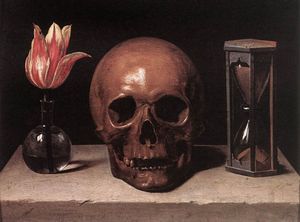
Any conception of mankind's awareness of death in existential philosophy is something like the memento mori [Latin: "Remember you are mortal."] in the realm of art. It became a tradition near the middle of the last millennium to include in portraiture a reminder of the subject's mortality--a less-than-subtle irony given the fact that a portrait is meant to bestow upon its subject a kind of immortality, at least as much as can be embedded in an image fixed upon a canvas. While the portraitee is situated in a time and place inextricably linked to their experience of life (even if idealized), the fact remains that the painting remains, while the subject does not. The "memento" in these works could be anything from a tiny skull on a mantelpiece, to an hourglass similarly placed, to a full-length, dancing representation of Death with his scythe. We can see it today in works ranging from painting to sculpture to literature, and even in song. The message of "Memento mori" forms the basis of festivals such as Carnevale and Mexico's Day of the Dead, Christian celebrations of life in the face of our own collective mortality. New Orleans, home of Carnival in the United States,* is also the home of a sanctified tradition known as the "jazz funeral." Led by a full-deco brass band (and sometimes two or three), the members of a funeral party wend their way through the streets, dancing and singing, waving their handkerchiefs and pumping their parasols in the air in a defiant final party for the deceased.** Man's*** knowledge of death is the genesis, the cornerstone of every great work of art, in whichever medium one might choose. Beethoven's "Ode to Joy" would be simply a minor section of a major work, were it not for the fact that its triumph, its "Joy," lies in Ludwig Van's momentary willingness to ignore our human mortality. Nobody would waste hours in front of Da Vinci's "Mona Lisa," jockeying for position with the hordes of photographic coup-counters, were it not for the fact that her enigmatic smile represents a stay of the inevitable (i.e. death) for both the subject and the observer. And what could explain our continuing fascination with Romeo and Juliet, without their acute recognition of life's temporal insanity and death's omnipresent finality?

And yet these mainstays of the Western tradition are nothing more than what Pascal would term "diversions," though they hold at their core an acute awareness of Man's mortality. Far from being modes of escapism, they express our collective knowledge (albeit anecdotal) of death. Life, however, remains at the fore as we find our expressions in song and dance, in inebriation and excess, in the general enjoyment of our temporary, earthly bodies. What more can we assume to be true? Yes, they are diversions, but in these diversions we find the most relevant, prescient experience of what it means to be alive, to exist. There remains a simultaneous recognition of death and life, an expression of Kierkegaard's "passion" that finds itself not bemoaning the nature of existence but rather embracing it for (and in spite of) its temporality. After all is said and done, the worst, most grievous diversion of all is the belief that any true understanding of life, death and existence can come from theoretical pursuits. These exercises in frivolity and notion can provide us with starting points for debate, with nomenclature and terminology and methods by which we can attempt to put our hands on such elusive, mercurial concepts--but in the end, each of us is given the task of making his own life. The "how" of existence is not something to be figured out as one would a mathematical problem.

In "The Myth of Sisyphus" Albert Camus writes, "There is no fate that cannot be surmounted by scorn." He likens our existential dilemma to the figure from Greek mythology, condemned to an eternity rolling a boulder up a hill only to have it roll back down each time he reaches the top. But Sisyphus understood the absurdity of his fate, and therein, according to Camus, lies his triumph. So, too, must human beings embrace the absurdity of our fate as mortals. What Camus called "scorn," the rest of us can regard as mere acceptance. Regardless of the diversions we seek--be they "dancing, playing the lute, singing, making verses, running at the ring" (from Pascal's "Pensées")--Death waits in the wings as "a possibility in every moment" (per Heidegger). This much is the only given of our existences. Understanding such a momentous truth is our task, one undertaken with all of Kierkegaard's "fear and trembling," but the end result must be one of joy, of passion for each successive, fleeting moment. Our response to "Memento mori" must be "Carpe diem!" To react otherwise would be to cheapen the value of any fear, any trembling, any angst, negating all the good that could come from any of the above. Existence precedes any understanding of it, to paraphrase the Dane. Life, in the end, is in the living of it--and that living is brief. Memento Mori, bitches, and Carpe Diem. Seize the fucking day.

*: Even if Mobile, Alabama claims the first celebration of Mardi Gras in the western hemisphere.
**: The "funeral" part of the term is a misnomer generally agreed upon, as the parades are nothing if not a celebration of life.
***: Please pardon my lack of political correctness. I use "Man" in lieu of "humanity" or another similarly loaded noun purely out of a desire for succinctness. I do not wish to alienate the fifty-one percent of the globe who respond to neither "Man," nor "He."

Friday, April 28, 2006

Friday's Exercise in Randomness

[Some random facts, musings, and assertions for a Friday afternoon:]

Swans mate for life, bears are notoriously bad with names, and a moose will never give you the correct time. Even if he's wearing a watch.

The only proper answer to "Do you have the time?" is "I've got all the time in the world for you, sweet cheeks."

The square root of 169 is 13, but math skills never got anyone laid. Isaac Newton invented calculus and died a virgin.

"E.R." is currently the only narrative on television to deal with the situation in Darfur.

If a tree falls in the forest and nobody hears it, could Manute Bol still use it as a walking stick?

We hold the truth to be self-evident that all men are created equal, but a black man in America only counted as three-fifths of a human being until 1865.

Thinking about baseball and envisioning Margaret Thatcher in B&D gear are the two most effective ways to delay male orgasm.

You can't fake a parade.

The only good elevator ride is a solo elevator ride.

Honestly, who throws his shoe?

Sometimes, no matter how cultured or sophisticated you would like to appear, an unexpected fart will elicit more than its due amount of snickering.

Yawns are contagious, but nobody knows why. My favorite theory is that they are a vestigial growl left over from our days swinging in the trees, and that their contagiousness is now merely an unconscious form of submission to the alpha-primate.

Monkeys fling poo, though I've never seen one yawn.

Nobody flosses three times a day.

Anyone over the age of 22 who watches MTV regularly is trying too hard.

Raiders of the Lost Ark might be the best movie ever.

On that note: Harrison Ford and Mel Gibson can only star in movies that involve threats against their families or wives (respectively), Al Pacino has been screaming instead of acting since his histrionics won him an Oscar for Scent of a Woman, and Robert De Niro needs one more sequel to Meet The Parents before I write him off completely.

Seriously, he's almost dead to me.

More people need to read Jitterbug Perfume, by Tom Robbins.

Hunter Thompson made up most of the drug shit in Fear and Loathing in Las Vegas. Still, it's a better story for it.

Grace Slick planned to bring a vial of LSD and spike the punchbowl during an invite to the Nixon White House. She didn't follow through, but that single act could have saved countless lives and changed the course of history.

I'm out, and I'll catch you all on the flipside. Have a nice weekend.

[After consideration, a brief addendum:]

The most effective means of delaying female orgasm is being the guy who thinks about baseball and/or Maggie Thatcher, with or without said B&D gear.

Newton also dabbled in alchemy and may have suffered from mercury poisoning and Asperger's Syndrome, a mild form of autism. No word on that information's effect on the ladies.

Cats always land on their feet, and toast always lands jelly-side down. I have yet to Smuckers a cat and test both hypotheses.

No matter how many stories up, it's always a kick to spit over the railing.

Tuesday, April 25, 2006

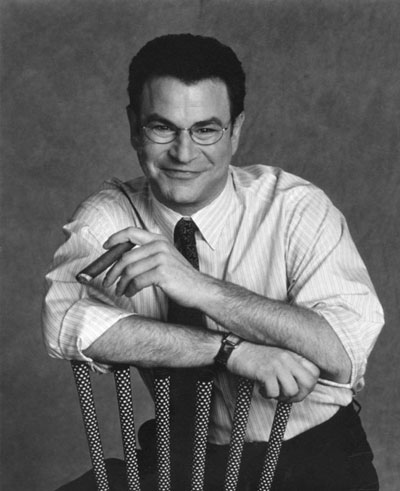
An Open Letter to Robert Wuhl

Mr. Robert Wuhl
Comedian/Actor/Writer/Filmmaker/Raconteur/Historian
Hollywood, CA, USA

April 25, 2006

Dear Mr. Wuhl,

Last night I had the privilege of catching your HBO special "Assume The Position." Your informative and amusing piece of revisionist history is up there with the best of Carlin and Miller; it’s highbrow didacticism that can still make you blow beer out your nose. I have been a fan of your work for some time, but this latest foray came as a total surprise to me. A totally pleasant surprise, I might add. I laughed, I learned, and I gained a new appreciation for your talents.

I admit that I have not seen your every film appearance, but I attribute that sad truth to the fact that you appear so rarely above the title. For instance: in order to see your performance in Dr. Jekyll and Ms. Hyde, I would have to fast-forward through the bland histrionics of Timothy "I Flew Airplanes For NBC And Now I'm A Gambling-Junkie-Punching-Bag On The Sopranos" Daly and Sean "No Need For Lengthy Nicknames, You Get The Picture" Young. I caught about thirty seconds of this film during a high school job projecting movies at a local multiplex, but they were regrettably not your thirty seconds as "Man With Lighter." I’m sure your cameo was brilliant in spite of its brevity. At the same time, it would be no overstatement to tell you I would have gnawed off my own thumbs to get out of that theater, had said thumbs been inextricably lodged in one of our hundreds of folding seats (deathtraps, incidentally) during a screening. An unlikely scenario, perhaps, but that's the kind of grotesque extreme such films force me to envision.

(I had a similar psychoallergic reaction to Crash, but my girlfriend was enjoying it and I was making amends for one thing or another. I should have just bought her flowers. As it was, I suffered a protracted recurrence of nightmares (bludgeoning and smothering) in addition to a sweaty, screaming, full-blown panic attack in downtown traffic following an Oscars party this spring. There was also the acute sense of free-floating paranoia I experienced while passing a Benetton store in Slovenia, but that's an experience I'd rather not examine in any great detail. We had broken up by then, the girl and I--but Crash was not your fault. You weren't anywhere near it. I digress. Back to the topic at hand.)

Your HBO special was a deft blend of comedy and historical analysis, a retelling of the myths we have come to accept and an explanation of what you termed “The Liberty Valance Effect.” As the man said, "When the legend becomes fact, print the legend." How very true. Hence: Columbus and Queen Izzy and no mention of the globe; hence: Paul Revere and not Israel Bissell, your "Jewish vacuum cleaner salesman"; hence: Jimmy Stewart getting fat (metaphorically speaking) on John Wayne's dime. History is pop culture, and pop culture has a selective and malleable appreciation of fact. Fiction sells tickets and ad time and newspapers, and truth rarely even rides in the back of the truck. Kudos to you, sir, for ushering this truth to the foreground of our society’s ongoing cultural debate.

Oh, and the way you manage to enlighten both your television audience AND a live classroom brimming with Impressionable Youth, educating and entertaining while still working blue? Bravo, Mr. Wuhl. I bow in awe.

It also happens that I recently revisited, by unrelated coincidence, your brilliant performances in Batman, Bull Durham, and Good Morning, Vietnam. Your fourth-, fifth-, and sixth-or-seventh-bananas (respectively) oozed your distinctive brand of charm, a quality born of endearing self-deprecation and good-natured, quick-witted impertinence. And let me also take a moment to applaud your slow-mo spit-take during Tim Robbins' naked-on-the-mound dream sequence in Ron Shelton's film. I have a feeling Costner would have asked for another take (and probably blown it, too), but you displayed a keen, instinctive awareness that the imperfection of the globule's arc only made the shot funnier. You showed us in that moment the difference between movie stars and real actors.

On that note I will mention "Arli$$" briefly, if only to defend it against some of its snarkiest critics, who continue to knock both you and the series in low, unsolicited blows. You played the lead among an ensemble of quirky sports agents, and perhaps the role followed too quickly on the heels of an overrated Tom Cruise vehicle called Jerry Maguire. Cruise pandered to his audiences' gullible inner romantics. He told us we completed him, we believed it, and even Oscar nearly swooned in starstruck bedazzlement. You, sir, received no such reaction to your demonstration of craft, which you starred in, executive-produced, and also (at points) wrote and directed. Perhaps the lack of consideration on the part of some naysayers could be due to the fact that they were unprepared for your clever, acerbic satire of sports and entertainment. Maybe they wanted more of Cruise's puppydog/pit-bull stare and last-minute declarations of "I Fucked Up But I'm Reasonably Certain At This Point That I Love You." Or perhaps it was due to a general unwillingness (theirs) to accept your ability to carry a thirty-minute pay-cable sitcom, though you did so for seven seasons. Allow me to explain this latter possibility by way of analogy:

I once read somewhere that moths gravitate suicidally toward bulbs and flames because of an optical illusion. Hovering in interrupted darkness, it seems they perceive a light's surrounding glow to be indicative of there being a greater darkness on the other side. Thus, in a mistaken, doomed drive to find the deepest precincts of the night, they unwittingly frizzle-fry themselves in the attempt to get there. I will assume the position that your critics wanted you to remain in that greater darkness beyond the glow of the superstars. In the throes of their conscious or unconscious starfucking, however--which starfucking, as you point out, is "American as apple pie"--they must admit the lure of the darkness beyond. It is there, paradoxically, where your performances shine the brightest. Maybe your critics prefer you to be further down in the cast listings, where your name is a subtle reassurance of quality, and from which position you can single-handedly redeem a shoddy picture without ever appearing obtrusive. Those performances remain, if you will, the honey mustard on the turkey sandwich of many a film--a graceful, understated accent that makes the more celebrated ingredients seem more flavorful, while never overpowering the way Dijon can.

Which is not to suggest that you should avoid the spotlight. On the contrary, there might very well be time and room in the Hollywood pantheon for a Wuhl to stand alongside the great leading men of-a-certain-age. It will, of course, take the right project. Here's hoping you find it. Bill Murray managed to recalibrate his career trajectory while pushing fifty, and Anthony Hopkins was fifty-four when The Silence of the Lambs took him from "respected actor" to Legitimate Movie Star. And keep in mind: the great Orson Welles was doing unmitigated trash by the time he was your age, eventually taking paychecks for frozen-peas commercials and voicing a Transformer in a full-length cartoon. Hollywood is a funny place, Mr. Wuhl, as I'm sure you know. There is time enough under the sun.

In the meantime, keep doing what you're doing. And do more of it, for chrissakes. You do it well. Your natural charisma may be an acquired taste for some, but The Great Unwashed rarely embrace anything but ersatz talents straightaway. Keep working your niche, Mr. Wuhl. Keep working your niche, and everything else will follow.

With sincerest admiration,

Nathan Gordon
Fan

Sunday, April 23, 2006

Running On Fumes

It's a bluebird day here in Bluegrass Country, and I've been watching it roll by beyond mesh screens as I slave away at the computer. Our mild winter was my first after almost a decade in the deep South, and it was nice while it lasted. But days like today make me appreciate springtime even when it's going on without me. The smell of cookouts and blossoming dogwoods, the sounds people make when enjoying the above smells, the sight of bare arms, legs, and midriffs on the female population--these are the things that make you want to sit back and smile, luxuriating in the beauty of our temperate climes.

Depending upon the research you believe, though, those temperate climes may be nearing their end. Global warming is happening as I write this, and carbon dioxide emissions are increasing the world over. China is burning coal at a rate that will see it equaling the rest of the world's combined smokestack output in a few short years. The rain forests are still being cut down, and urban green spaces are still endangered species in their own right. People in the States are driving bigger, less efficient vehicles, and any viable alternatives to fossil fuels are a long way from hitting the mainstream.

This Earth Day saw regular gas prices nearing four dollars around San Francisco and other major metro areas, and we're paying almost three here in Kentucky. Full disclosure: I've got a big red Jeep that I feel guilty driving anymore, but I can't afford to go hybrid or biodiesel or anything else just yet. I drove the Jeep out West in 2004, when gasoline prices were around $2 a gallon at the high end, and I remember cringing when I compared my gas budget with those of previous cross-country excursions in my trusty Honda Civic (the Jellybean Express, or "Bean," so-named for its vaguely pinkish hue). The Bean was a paragon of fuel economy, and it made possible the kind of Great American Road Trip that this country has held sacred since the dawn of the Automobile Era. It's not simple rhapsodizing when I tell you that the American West is best viewed from behind the wheel of a car doing eighty on a straightaway, sun shining through open windows as red desert rolls into purple mountains' majesty stretching the breadth of the horizon. That's freedom, baby--extra large with fries and a shake.

It's also what Bobby Troup was talking about when he wrote a catchy little ditty about Route 66. That road is now officially defunct, but you can find its remaining stretches around the western side of I-40 with a good map. The halcyon days of the road trip may also go the way of 66--that is, if they aren't already dying on the vine of communal memory. You can't just pack up the family, turn on the radio and explore anymore. Not with gas at these prices.* ExxonMobil posted record earnings of $36.1 BILLION dollars in 2005, but their shareholders are the only ones enjoying the windfall. Even they might be forced to hock a few stocks to put juice in the family wagon, as the rest of us just bend over at the pumps (and do a lot more walking), wondering why we're really at war.

It's a terrible, crowning irony that when you go out in search of America, you usually wind up spoiling a little bit of it in some way. Driving through Yellowstone the few times I've been, I always hated the fact that to get anywhere in the park during the summertime you had to sit in traffic, choking down the collected emissions of hundreds and thousands of other vehicles. The walk from the parking lot to Old Faithful takes several minutes while you pass dozens of rows of variegated metallic beasts that get bigger and louder every year. But whaddya do? It's America, that parking lot. And those childlike smiles on everyone's faces when the geyser gets going? That's America, too. And sadly, America is now also a place where such smiles carry a nastier price tag, in terms of both dollars and geopolitics.

You might recognize Winslow, Arizona from the Eagles' "Take It Easy," the tune with Glenn Frey "standin' on a corner" (and there's a small park with a bronze statue of Frey standing on--yup--a downtown corner). Winslow was once a much busier stop along Route 66, but since the interstates were built it's dwindled to a speck in the desert near Meteor Crater. The trains still roll through, and the few motels in town do summertime business with roadweary families stopping for the night. But if the motorists stop motoring, towns like Winslow across this great nation run the risk of turning into so many ghost towns. I can think of few things sadder than imagining my city-dwelling children hearing about the good old days, when their old man could afford to hit the road with only a few hundred bucks to his name and see the wide-open expanses of Flyover Country, long-lost places with names like Tucumcari and Choteau, Green River and Mountain Home.** When airline travel becomes more affordable than the Great American Road Trip, whole stretches of Americana might disappear into history.

I might be accused of speaking hyperbolically and pessimistically on this point, but the greater point remains: we're at a crucial moment in the history of our nation, and gas prices are one symptom of a worsening disease. So what can we do about it, right? How do we preserve our uniquely American experience while crossing such dire cultural, economic, and ecological straits? We can start by haranguing our representatives in Washington who consistently shoot down efforts to make American vehicles more efficient. We can support legislators who support broad strokes like the Kyoto Protocol--which our current administration has ignored, much to the chagrin of the global body politic. We can do our level best to rein in our own emissions, whether that means getting a tune-up or buying a Prius. The problem is bigger than any of us, though it's not beyond changing. Not yet. But the future is happening everyday, and every day that nothing changes means we get closer to a time when you can only see America from the tiny windows in coach class.

And who knows what it might look like by then?

*: Although Barry Sonnenfeld's upcoming RV, starring the recently-just-depressing Robin Williams, seems to be selling just that. It looks pretty lighthearted and the trailer doesn't offer many clues, but I would be interested to see if the issue of gas prices comes up even as a throwaway line. I'm placing no bets, and I'll have to hear about it secondhand. Those nine dollars will almost buy three gallons.
**: Respectively located in New Mexico, Montana, Utah, and Idaho. The latter is curiously removed from the nearest mountain range, more than a hundred miles away. Nobody I asked could offer anything in the way of explanation, but I figure it might be like calling a one-armed southpaw "Righty."

Thursday, April 20, 2006

God and Man and Things and Such

[So I had to write a term paper the other night on the debate between evolutionists and proponents of intelligent design. Bummer of a debate, given that science must deign to debate pseudoscience in today's Big American Theocracy. But that's beside the point, really. I started thinking about creation, at least as the Christians see it, and I realized that it's a good story. It's a great story, but no better or worse than any other. When you're arguing from a basis of faith and not objective truth (lower-case "t" and finger quotes here), any story is equally as good as the rest. For my money, I don't think it gets better--in terms of stories--than the Navajo, who believe that Coyote (the trickster) flung the stars haphazardly into the sky when he got tired of waiting for the First Man and First Woman to do it proper-like. I'm paraphrasing, but that's a damn pretty picture. Anyway, I started wondering what a modern creation story--and I refuse to employ the term "myth" for its loaded meaning--would sound like, one that incorporates what we know and what we're taught. I think the following is a fair assessment of the situation as it stands. The language is what it is, but I think "the facts" are accurately represented. If you find errors, please point them out. I appreciate it. -NG]

IN THE BEGINNING there was the void. There was a flash and a bang. And Things started expanding.

Again.

(Which is to say that they had expanded before, and contracted. And this time Things were expanding. Again.)

Except: there could not have been a bang, really, not even a boom or a poof or a fizzle. There is no sound in a vacuum, and the void was nothing if not a vacuum. Anyway, nobody heard it.

So what was there? One moment there was nothing, and then there was a something so big that it is still expanding, after billions and billions of years. Some of the little bits of that original something glow in the sky at night, and we can even see the closest glowing bit during the daytime. It is warmth, and It is Life, and we see more of It at some times than others. People have called It different names: "Sol," "Father," "Ra." The names do not matter, not really. It is still there, still there, still. There.

But people are a long way off yet. Back to "IN THE BEGINNING." First Things first. First there were Things, and It was one of those Things. And It was warm, and It was Life, and there was Life here on one of the conglomerations of other Things that circled around It. And Life was small, at least at first. Life got bigger. Life grew gills and legs and wings, and Life decided it enjoyed sand as much as water, and earth as much as sand, and sky as much as earth. Life even decided it could make a place for itself in the volcano and under the ice, though without the gills and the legs and the wings. Life was nothing if not amenable to places amenable to Life.

Oh: there were volcanoes. And there was ice. And there was sky and earth and sand and water. And other Things, too. But those Things are only things, and Life was concerning itself with other matters. Life was concerning itself with bugs and spiders and parrots and lemurs and butterflies and lions and tigers and bears and (oh my!) people, and people looked really funny at first. Hairy and thick and coarse and generally not the kind of people people would invite for dinner.

And people moved, and people prospered, and people eventually stopped dragging their knuckles when they moved and prospered. They started walking upright, and people found that walking upright gave them a better view of It. And in the course of Time--another thing people found it advantageous to invent--people started seeing It for what It might be, metaphorically and literally.

They made offerings to It, in the hopes that It would continue to shine and be merciful. Some of those offerings bleated and bucked because they could not understand their importance in the scheme of Things. Some of those offerings screamed words known to the people watching, but the words never lasted long.

And It continued to shine and be merciful--though more merciful at some times than at others. And people dug the good times, and they suffered the bad times in the hopes that the good times would follow. People knew that It was fickle, and yet somehow constant in Its fickleness. Some people started wearing little hats or big coils of fabric on their heads because they thought It might be watching them. Judging them. They thought It might see the bad things they do, their nighttime things. Yet there It is the next morning, just like the day before.

Maybe they know that It will expand and burst into giant tongues of flame like other things in the nighttime. Because It will, eventually. Maybe they feel better hedging their bets until then.

They turn their heads to It when they have a question, a want, a need, but they avoid staring directly at It. Because they know one thing for certain: you can ask It a question ("Whywhenhow?"), but It provides no answers. It does not reply. It need not reply.

And that, as the wise man knows, is Power.

Monday, April 17, 2006

Scattered, Smothered, Covered: In Praise of the American Breakfast

I took an extended sojourn in Europe last summer as a sort of recharging period between quitting my job and finishing a long-in-waiting university degree. One of my stops was in Budapest, a beautiful city (cities, really) straddling the banks of the blue Danube. I was couchsurfing with a lovely Hungarian woman, Gabi, who bent over backward to show me her hometown. She ferried me around the city in her zippy European hatchback, showing me out-of-the-way destinations I never would have known existed and serving as general-purpose translator for an American with scarcely a phrasebook-level grasp of the only hermetic language in Europe. Gabi had been to the States before, stopping in New York and San Diego at various points for business and pleasure, and her impression of our country was most evident on my last morning sharing her flat, when she offered to cook me a "real American breakfast." She mentioned the idea the night before and I quickly approved, as she'd already prepared me some Hungarian dishes that were unbelievably good. I awoke that morning to the heavy summer breeze wafting through her open windows, the whole place already redolent of porksmoke and coffee--real American-style coffee, meant to be consumed in large mugs and in no way resembling the freeze-dried instant varieties I found elsewhere in central Europe. I walked downstairs bedheaded and smiling, offered a Good Morning in my broken Magyar, and was immediately taken aback by the sheer volume of the meal that awaited me.

There were cereal flakes poured into a bowl only slightly larger than the massive coffee mugs, an open carafe of fresh milk situated nearby. Some Hungarian sausage I had enjoyed on previous mornings was spread out on a platter in all its thin-sliced, paprika-laced glory, alongside a fist-sized chunk of a sweaty local cheese that was pungent and delicious. A glass of fresh orange juice--a delicacy at any time of year in the States, and even more so that far from the groves--sat next to a selection of teas behind another large mug, which was itself abutting the tray of pastries and toast ornamented with pats of real creamery butter. And Gabi stood smiling at me from the stove before she turned her attentions back to the 12-inch skillet nearly overflowing with beautiful, fluffy scrambled eggs punctuated throughout by thick chunks of smoky Hungarian bacon.

After my initial reaction of "God! that looks better than sex," I realized that this entire spread--easily 10,000 calories and collectively weighing in somewhere just under a bull rhino or Fat Elvis after a Vegas buffet--was intended for me and me alone. Gabi had already taken her toast and tea. So I was immediately faced with a couple of realizations regarding my potential responses to the luxuriant smorgasbord before me: either I attempt to eat it all and reinforce her apparent conception of Americans as oblivious gluttons idling in the Land Of Plenty, or I pick and choose my battles on the breakfast front and risk coming off as your typically ungrateful Ugly American abroad. I wound up eating just past my fill (and loving every bite) over the course of an hour or so while we talked about the issues of the day, me and my Goddess of the Morning Repast. I complimented everything she had prepared with an enthusiasm that probably bordered on obsequity, and she accepted my thanks with a gracious, downcast smile. There was an obscene amount of food left over, much of which would go to waste, and as I did the dishes (the least I could do) I offered apologies for my lack of appetite. In her splendiferous, idiosyncratic English, jeweled in Hollywoodisms and gloriously untranslatable French, Spanish, and Magyar idiom, she explained that my worries were unfounded but endearing. It seems she never really expected me to finish everything, but it would have been rude on her part to underestimate my capacity for putting away what she regarded as a potentially regular-sized American portion.

She had an interesting point, and we talked about it for a while as we cleared the air of any cross-cultural misunderstandings. She reminisced about being shocked by the size of the portions at the restaurants she had visited during her time in the States, and I explained that my people also have a correlating fondness for the doggie bag (an amusing attempt at translations ensued) that cuts across every echelon of our dining experience, from the paper sack to the decorative foil swan. Yeah, we Americans eat more in a sitting than most Western cultures do in two meals (or three), and we tend to view these large portions as our entitlement for spending the money. The All-You-Can-Eat buffet is as American as the apple pie waiting on the dessert cart, and it's no accident that obesity, diabetes, and heart disease are among our top killers.

Which is not to say that I don't partake in the above rituals of Americana. I love a good meal as much as the next guy, and a big breakfast is one of my many occasional indulgences. On several road trips Westward I've lamented the passing of the last Waffle House as I hit the Texas-New Mexico border; I've eaten a whole trout with home fries and baked apples before 10 AM in Jackson, Wyoming; I've killed a tall stack of pancakes with four pork sides at a diner in Pocatello, Idaho--and after all these meals I'd get back on the road beaming, sipping a go-cup of coffee and anxiously awaiting the next big-sky adventure around the bend. I love waking up late on a Saturday morning and fixing bacon or sausage with a well-appointed scromelette, a lazy-man's-eggs requiring no flipping skills that I learned on a rafting trip down the Colorado. And during my long tenure in New Orleans, I found that there was no cure for a toenail-curling hangover in 90-percent humidity like a Bloody Mary at Igor's followed by a greasy breakfast on the patio at Slim Goodie's. Every evil deed conducted on a Saturday night miraculously evaporates with the languid perspiration of a muggy Sunday morning. That right there's absolution, baby, and it tastes great with hash browns and a little hot sauce.

And while some would view such predilections as exercises in overkill, I see them as the icing on my American Pop-Tart. There are plenty of mornings I race out the door with nary a nibble in the belly, so the times that I can have a leisurely breakfast, read the paper, maybe do the crossword--these are the days for which I slog through the rest of the busy week. They're a reward and a motivation, the rabbit for my greyhounds, the carrot for my mule. But that morning in Budapest I felt suddenly, acutely conscious of how the rest of the world must view such tendencies, and I wanted to atone more than I wanted to strap on the feedbag. There was a lingering, palpable guilt that overtook me, but I'm now sure that part of it must have been simple homesickness. I think Gabi understood, and I take solace in the fact that such a culture-clash moment ended in mutual understanding. That feeling has only made me appreciate more intensely the little things we too often take for granted in America, and I do so every time I sit down at the Casa de Waffle, during whichever hour of the 24 I decide to take my breakfast. If only I could find more places in my ZIP that offer a five-egg platter and Bloodies on a Sunday forenoon, a little good news in the local paper would be all I'd need to think--if only for a minute--that everything was right with the world.

Friday, April 14, 2006

Don't Gimme No Lip: Comedy And The Moustache

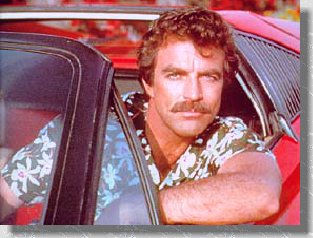
Whether or not you've seen the actual show, you are by now probably aware that Jason Lee's "Earl" (as in "My Name Is ____") is the most extravagantly moustachioed man on American television since Tom Selleck last drove a Ferrari. Earl's moustache is his calling card, a point of pride, the silent punchline to every joke the show doesn't have to tell. Lee plays Earl as a lovable rube who happens to be wiser than he realizes (strangely, though, exactly as wise as he lets on), and the moustache lends him an air of redneck enlightenment I'm hard-pressed not to associate with the bristly-lipped philosophers of years past, sage old souls like Confucius and Groucho Marx and Ned Flanders.* In a recent episode Earl's camped in a tree outside a little boy's window, talking the kid through a fear of the dark and the boogeyman that Earl himself unwittingly created during a botched robbery (long story, and the reason God created reruns). So while Earl's out on a limb (literally here) playing surrogate father to the kid, answering questions about life and such, the question of Earl's moustache comes up in the course of conversation. The kid asks something to the effect of "Do you like your moustache, Earl?" To which Earl responds:

"Let me tell you something. As soon as your body is ready...grow one."

It's not the sincerity with which the response is delivered that makes it so spit-take funny, it's the way Lee imbues those last two syllables with the wisdom of the ancients, as if he's passing on a well-guarded secret more boys should be hearing at that age. I'm wondering if high school yearbooks for the Classes of 2012 will feature more than the usual amount of facial fur, the eyes above their fuzzy upper lips twinkling with all the honeysweet secrets of time immemorial. It's a fine image, if perhaps too optimistic a view of today's youth. Alas.

There's been no shortage recently of moustaches in American comedy, and Earl's is only the most frequently visible incarnation. The Will Ferrell vehicle Anchorman is a prime example of the trend, as is "Reno 911" (and "COPS," for that matter). And (although I'm ashamed to cite it) in the Farrelly Bros.' Me Myself and Irene, the flashback scenes are indicated as being such not by the standard devices of wavy dissolves or a different film stock, but by showing all the male characters looking exactly the same as they do in the present, but with moustaches. These cases all get at the root of why the moustache is making a comeback, but they also ask the question of whether or not it counts as a comeback at all. You see, the moustache is funny in the above because it's an anachronism. It's a choice, and an ironic one at that. When I referenced "Magnum, P.I." earlier it was no accident. It's really been that long since the solo moustache was a cool thing to have (not unlike a T-Top '83 Firebird, Linda Evans, or a Members Only jacket). Anchorman was set in the mid- to late-70's, "Magnum" was a hit in the early 80's, and cops everywhere just stopped evolving at some point in the Paleolithic era. That they can shave their foreheads is a fucking miracle. They'd get the moustache too, but they haven't yet invented a stone tool that can handle those delicate spots under the nose.

The fact is, outside of Queen tribute bands and the homosexual arena** there's very little place for the moustache in today's cultural landscape. Sure, rock stars rely on creative facial hair to establish themselves as being anti-establishment. Of course there are an assortment of other artists and Hell's Angels and thinkers and the like who don't have to endure job interviews in suits and ties. And it's a given that the occasional woman enjoys a bit of a tickle (not a scratch, mind you) on the ol' Ship's Captain (you know, when it's her birthday or you're just really enthusiastic about being down there, you know, facially***). But by and large, the people seem to be past the 'stache in our go-go modern era.

Who knows, maybe the moustache'll make a real comeback someday soon. The youth are out there, and they might be watching NBC (nobody else is, that's for sure). I've been sporting a semblance of one for a good while now, but it's more out of the aforementioned sense of irony. You'd be amazed the kind of shit you can get away with saying when you've got a goofy-looking distraction under your nose. It's accompanied at the moment by a Guy-Fawkes-lookin' stripe heading chinward that's (I guess, technically) a modified Soul Patch, or what Kinky Friedman once called a "White Man Hater." But times are changing, people. We may soon see the return of a bearded President of the United States. As the old (though long-abandoned) saw goes, you vote for the most convincing moustache. Just think, our Idiot-In-Chief could hide behind his facial scruff instead of finding a safe place behind bullshit rationales for war and a cabinet of theocratic yes-men who'd rather suck a tailpipe than get off the military-industrial gravy train. One thing is for certain: no culture with so many names for the various permutations of hair below the hairline can go long before the pendulum swings back in favor of Mr. Flanders' "Fuzzy Neighbor." I'll be waiting there at the crossroads, my brothers, waiting for Earl and Ned and Freddie Fucking Mercury to show us the way to the Promised Land.

There'll be donuts, ginger ale, and fondue for anyone interested. BYOB.

*: Buddha was clean-shaven, but I like to think it was a choice he made to match the belly and the chrome-dome. We all know how Mrs. Buddha loved the round, smooth type.
**: Really the same arena, and quite an arena it is. The speakers are constantly thumping out Cher's latest and greatest, every stall in the men's room has multiple handlebars and a bidet, and the rainbow pennants hanging from the rafters are just FAHbulous. If the Moustache Pride movement developed a logo, it'd be a rainbow (because it's kind of that shape, you see?), dazzling the eye in a dizzying spectrum of blonde, dirty blonde, brown, black, and grey.
***: And believe me, ladies, I've got enthusiasm to spare. Though I've always secretly thought cunnilingus was kind of like Vietnam must have been: it's hot and wet, you're not really sure if your being there has a purpose, and after all the bombing and shelling you can't even remember the alphabet.

Thursday, April 13, 2006

This is not a blog...or is it?

[Alright. I have to write a proper academic paper this afternoon, so this is going to be a bit of free association, a little palate cleanser. This post is the tiny scoop of sorbet (with the tiny silver spoon) before I get down to the main course, before I get my fingers all greasy and eventually have to ask for a WetNap. I like the lemon-scented ones the best.]

I caught one of several "Seinfeld" reruns the other night, the one where Jerry catches Uncle Leo shoplifting in Brentano's. When he mentions later to Leo that he saw him in the store, Leo takes offense that he didn't say hello. This minuscule breach of etiquette, of course, is a big deal that totally eclipses (in Leo's mind) the fact that he was busy smuggling books out in his coat at the time. So later there's a quick sequence where Leo's doing pull-ups (a la De Niro in Scorsese's Cape Fear and Mitchum in the original), and there are tattoos visible on his fingers (after De Niro again, and Mitchum in Night of the Hunter) as they wrap around the bar. One reads "JERRY," the other reads "HELLO," and he keeps repeating this as he's doing pull-ups that terminate their upswing in a close-up. "Jerry!" "Hello!" "Jer"--well, you get the point.

So that reminded me of this argument I wound up in one late night (more likely an early morning) in Miss Mae's at Napoleon and Magazine. There was this heavily tattooed cat (on one hand "HELL," on the other "FIRE") playing pool against me, and for some reason (!) he brings up the subject of tattooing, asks me why ain't I got any ink. Tipsy off dollar doubles and red-can Beast, I tell him that I'm reserving the blank canvas of my pasty flesh for some South Seas native tattooing with the long stick barbed with fish teeth. It's a rite of manhood in some cultures down there, and if you wince or cringe or cry out "Motherfucker quit POKING me with FISH TEETH!" you've gotta like retake the oral and written portions before they try inking you again next year. So HellFire starts in on me (don't know what he was drinking, but it was probably some really angry gin), calls me a fucking poser or something for not wanting a "real artist" over here to ink me up. And by now he's taking personal offense, getting really pissed off. I'm thinking "Man, that's a cold bowl of chili for this time of night," but I defer to HellFire (never know who's got a shiv at 5 in the morning at The Club) and eventually just sink the eight ball and assent that yes, indeed, I'm a fucking poser-ass sissypants. Point taken, game over. Peace. Out.

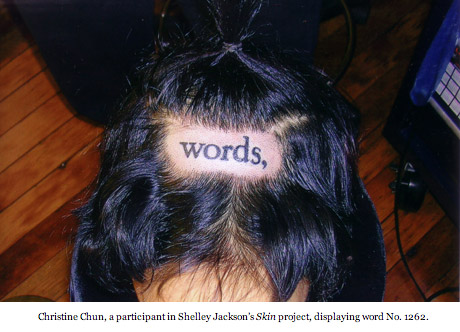
Then I'm reading in The Believer a couple of months ago (Dec/Jan issue) that there's this author, Shelley Jackson, who's tattooing 2,095 people from all walks of life, each with a different word of a short story that will never be published on paper, the entire text known only by the people who serve as her canvas/word processor. Called "Skin," it's being hailed as a landmark in literary deconstruction, entirely removing paper and print from the literary equation. Everybody's got a different reason for going along with the idea: "One participant is a book collector who saw the project as an opportunity to collect a rare manuscript. Another liked the notion of 'a text written on bodies and the idea that the text would encounter erasure with death and time.'" Some bitchin' ink right there, if a bit high-concept.

I'd definitely get in on that (mostly because I want to read the story), but alas, Jackson's got more than enough volunteers. Until then I'm sticking with my original idea, which involves a large, stylized hammerhead shark on my back. The hammerhead is a potent symbol of the sea for the Maori and in other island traditions, both for its unusual shape and the way that strange physiognomy helps it get around. A shark's snout is embedded with thousands (millions?) of little jelly-filled pores that detect electrical currents in the water. They're collectively called the ampullae of Lorenzini, and they're the reason you can chum a spot in the open ocean and attract sharks from dozens of miles around. It seems the hammerhead has more of these ampullae--or it's their arrangement across the broad "hammer" of its "head," I forget--but either way the shark can navigate along a hunting field that stretches hundreds of miles from a home territory, which is usually near a seamount in shallower water. The hammerhead follows the lines of alternating polarity in rock extruded from rift zones, and can get out and back because of its extreme sensitivity to the magnetic fields on the ocean floor. So this silly-looking beast is actually a highly-specified product of evolution. Pretty cool stuff.

Which reminded me of an ad campaign run by New Orleans' Aquarium of the Americas a few years back, where billboards and taxitops featured a picture of a shark charging the camera. The copy read: "This is not a shark." And they were right, in the strict literal sense. The real shark, they were playfully suggesting, could be found on a visit to the Aquarium. It's something like Rene Magritte was getting at when he painted "The Treason of Images," a picture of a tobacco pipe with the inscription "Ceci n'est pas une pipe." ["This is not a pipe."] Both of these drew a fine line between art and experience, between representation and reality, a line that we often take for granted. Sure, it's not a pipe. You can't hold it, light it, or smoke it, right? Magritte asked the question "What is art, and where does it fit into our experience of life?" Marcel Duchamp made an earlier statement on a similar theme when he signed a urinal and displayed it at an exhibition in 1917. He called it "Fountain," and he was declaring that it's the intention, not the medium or the final expression, that matters in art. It might seem like he was taking the piss (pun obviously intended), but the questions he raised (along with the snickering) continue to influence our conception of art as it relates to a life being lived.

Aristotle said something in his Poetics (and I'm paraphrasing here), that "Art completes Nature as Nature would complete herself, were she Art." Given that most people will tell you they got a tattoo to commemorate a particular event in their lives, or to memorialize a fallen friend or relative, or to remind them of the beliefs they hold dear, the tattoo would seem to be the ultimate convergence of art and the existential human experience. Whatever the reason--even something as simple as "I enjoy getting tattooed" is unassailably valid as an assertion of principle--the commitment of an idea to skin is a unique expression of one's identity, a personal reminder of place and time. That being said, if I ever meet HellFire again in a darkened alley, I might want to have some temporary tats on hand in case I haven't yet made it to the South Pacific. It might be difficult to explain the greater significance of a hastily-applied Huckleberry Hound's location on my right knee, but I'll take an ounce of humiliation over a pounding by an unstable fascist any day of the week.

Monday, April 10, 2006

"United 93" and America's Wounds, Still Bleeding

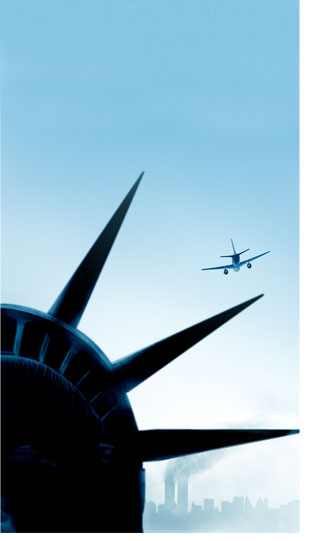
I went to see Lucky Number Slevin yesterday (not great, not bad), and one of the trailers before the film was for United 93. This is writer-director Paul Greengrass' telling of the fourth hijacked flight on September 11, 2001, the one taken back by its passengers before it crashed in a Pennsylvania field. Not surprisingly, there is a fair amount of uproar surrounding this project. For his part Greengrass claims the unanimous support of the families of Flight 93, without whose backing and consult he says he wouldn't have gone ahead with the film. Nevertheless, not everyone is overwhelmed by enthusiasm for the project. There have been reports of audiences in LA shouting at the screen, "TOO SOON!", of overcome New Yorkers leaving the theater in tears during the trailer, which features CNN footage of the second plane just before it slammed into the South Tower. At the risk of trafficking in understatement, this is clearly a subject that many Americans are not yet comfortable reliving.

And this isn't the first time Greengrass, an Englishman, has dealt with sensitive material. His 2002 Bloody Sunday is a remarkably effective, balanced telling of the 1972 massacre by British troops of protesters in Derry, Northern Ireland.* He manages to interweave documentary-grade verisimilitude with personal portraits of the day's victims, orchestrators, and those who tried in vain to stop the events already in motion. The film ends with an arresting sequence showing the galvanizing effect the unwarranted killings had for local IRA recruitment.

He has similarly fertile soil to work with in United 93, the opportunity to craft a statement about how an act of war can simultaneously bring a nation together and potentially lead it into a dangerous, unmitigated cycle of attack and retaliation. But the question remains: are we ready for this--or any--portrayal of events nearly five years past, yet still too fresh in so many minds?

Greengrass is not the first to use his art form to examine the effects of 9/11. Spike Lee made his 25th Hour an oblique commentary on New York's reaction to the tragedy. A number of documentaries have dealt with 9/11, and the Discovery Channel recently aired a TV movie about Flight 93 to the network's highest-ever ratings. Even Oliver Stone has an upcoming film called (appropriately) World Trade Center, about Port Authority workers trapped in the rubble of the Twin Towers, starring Nicolas Cage. But United 93 is the first feature production of its scale** to put us on the plane that fateful morning, the first to ask us to reexperience, in a darkened theater, our shock and disbelief as we watch the story unfold from the viewpoints of the ordinary Americans onboard.

This seems a tall order for a mainstream Hollywood venture, especially at a time when we are still dealing militarily with the repercussions of 9/11. Zacarias Moussaoui looks like he will face the death penalty for his part in the hijackers' preparations, as he sits before a jury that will have heard dozens of horrific tales from victims' families recounting their loved ones' final moments. And, of course, there is the trailer's reception as the film's release date looms (April 28). All of these factors might make United 93 either an unprecedented word-of-mouth hit or one of the biggest fiascoes in modern cinema history, a victim not of 9/11, but of the American public's awkward, labored coming-to-terms with that thunderbolt morning.

I have my private reservations, but I'll wind up seeing it. Tell me what you think. Leave a comment, yes or no, and maybe a few words. This is something we all, as Americans, have opinions about. I'd like to hear yours.

*: If you don't know Bloody Sunday, think Kent State. Add hundreds of years of English political and military oppression of the Irish people. Multiply it by decades of terrorism and urban guerilla warfare waged among civilian populations on both sides of the conflict. You'll almost get the point.
**: Universal has its money behind United 93, though the film is conspicuously lacking in starpower. This could be due to the filmmakers not wanting to distract from the "real Americans" element of the story, or because there's no way your Clooneys and Pitts would risk the potential hit to their Q-Ratings. Perhaps a convenient mix of the two. You be the judge.

Saturday, April 08, 2006

Flaming Smudges of Death! Or Spiritual Cleansing!

So I'm checking out McSweeney's today and there's something interesting at the top. Under the masthead they write a little addendum that changes every morning, illuminating another facet of the mysterious Timothy McSweeney. While he doesn't actually exist in any corporeal form (he's a figment of Dave Eggers' imagination, but the folks at the quarterly correspond occasionally with an unrelated Timothy McSweeney somewhere in like Limerick, Ireland), these little tidbits combine to make up a remarkably three-dimensional character. One day you'll discover that "All Timothy McSweeney's Elvises are velvet," and the next they'll reveal that "Timothy McSweeney's superhero nickname is The Trampoline."* Well today's sidenote on the fascinating T.McS. is that "Timothy McSweeney burns sage, not flags." I had a little flashback reading this pronouncement, as I've only known one person who swears by the sagesmoke.

[cue flashback music, roll thunder and lightning]

I was working at The B_____, a music club in New Orleans, and we got our share of idiosyncratic musicians. Some had particular drinks they wanted prepared in particular ways (one brass band even renamed the LIT after themselves), some needed a certain arrangement of candles that had to be set out just so, some had special tip jars decorated in mosaics of broken bottleglass they insisted upon using--exactly the kind of personal tics that you'd expect from performing artists. This one woman, K_____, had a pre-show ritual she'd run through with her dreadlocked boyfriend (and cheering section) whereby they'd light a bundle of sage leaves and walk around the perimeter of the stage. When they had covered the entire area with their purplish haze, they'd waft the strange-smelling smoke over the piano, then the piano stool, then the speakers, eventually stopping by the microphone to let the smoke curl around its stand and main apparatus. The first time they did this, I was coming out of the walk-in cooler carrying cases of beer and I thought somebody'd lit a really nasty doobie on the dancefloor. That kind of stuff'll fly when the room's full and the music's thumping--people are always willing to look the other way when you're burning one at a concert. But when it's an empty room, paradoxically, the smell of somebody having a talk with ol' Bob Hope triggers a paranoid response that makes me think "Shitshitshit, we're gonna get caught." And when that happens, of course, the shit falls in my lap. As a manager in the establishment, my main responsibility was managing not to get fired (and that was a fucking miracle some weeks). So after I recovered from nearly dropping the beer I put on my best WTF face and strolled over to the stage to figure out what was going on.

"We're just burning sage, man."

"Yeah, it purifies the performance space and drives out bad energies."

"Yeah, man. With all the crazy shit around here you never know what kind of energies you have to deal with. This takes care of all of them."

I couldn't argue with the "crazy shit," having seen more than my fair share at one club or another. Duly educated and up to speed, I gave them a tolerant smile (probably more patronizing than it needed to be) and went back to purifying my own performance space behind the bar, which involved the highly spiritual and sanctified ceremony of spraying for fruit flies and emptying the beer traps.

And that was the last I heard of the whole burning sage thing, until yesterday. My curiosity piqued, I Googled "burning sage" and found that it's common practice in several cultures for just the reasons outlined by K_____ and her stoner companion. It seems the Lakota Sioux of the northern Great Plains use a burning smudge (the bundle of tied sage, pictured above) to purify their sweat lodges before rituals, and it's also an important tool during their Sundance (which, I'm assuming, is a dance for the sun-god or something. Maybe I should Google that, too.). The Latin root of sage, "salvia," comes from "salvare," meaning "to heal." And Paul Chirumbolo's "Guidance To Change Your Life" website has this gem of New-Agery on its sage page: "By allowing the purification and cleansing properties of sage to clear your items, your body, or your rooms, the space is created for new awareness and new direction to begin to take its place."

Who knew? Maybe I've been stifled by the old awarenesses and directions taking place in my particular spaces. Perhaps I should burn a smudge or two from time to time, you know, to "Give special attention to areas of stress and unbalance in relation to the individual spirit-body." Good news for me: since no sacred ritual remains that way in a capitalist system, I can buy bundles of white sage from Taos Herb Company for the lowlow price of $17.95. Or I can upgrade to the Premium Blessing Collection for $69.95, which comes "Just in time for the Holidays!" And look how much more I get! "Presented in a beautiful birchwood box are New Mexico Sage & Cedar and White Sage Smudge sticks, Sweetgrass Braid, Lavender Flowers, Copal Resin, Frankincense Resin, Myrrh Resin, a roll of Charcoal Tablets, an Abalone Smudging Shell, and a hand-painted Eagle Feather used to fan the sacred smoke."

Frankincense Resin? Hand-painted Eagle Feathers? Funny, I'm reading "Abalone" but I'm thinking "Ah, baloney." Call me cynical, call me skeptical, call me a killjoy (but call me), but I figure a jar of sage at the store is about $2.99. That's exactly the price I'm willing to put on the sanctification of my personal spaces, and I think it's a bargain. Do you think the gods care if I'm trying to purify my shit on the cheap? Do they look down on frugality? I might just burn some sage sausage tomorrow morning at breakfast, see if I can simultaneously create new energies while causing a pork-based mid- to large-scale grease fire in my tiny apartment kitchen. I'm guessing not. The Lakota would use turkey sausage.

But that's the spiritual lesson for the weekend, folks. Feeling a little rusty around the edges? All your new ideas somehow hackneyed and stale? Is what you do in the bedroom starting to feel like what you do in the boardroom? Burn a little sage, people. Take the wisdom of the ancients and put it to use in our 21st Century. I'm burning some right now, and I'm in good company. In fact, we're getting together later for chai tea and a drum circle if anyone's interested. Should be a groovy jam, man. Peace.

*: Neither of these are actual McSweeney's posts, but you get the point.