Saturday, July 15, 2006

Bugger Off, Little Man, And May Pestilence Follow Thee All Of Thy Days

[So it's been a few weeks now since I went completely culture-snob, but it's time I got the following off my chest:]

As a society, as a people, as a country at war with those who would seek to destroy our way of life, we have been fighting on the wrong front(s). Iraq and Afghanistan and (soon-ish enough) Iran are one thing, but Little Man is another. In fact, it would be a fair assessment to state that the new Wayans film represents many of the reasons crazy people want to fly planes into our skyscrapers. I don't think I'm engaged in hyperbole here. Really. Let me explain...

A few months back, I wrote about the furor surrounding the first trailer for United 93. This was a moment in American film that polarized our moviegoing public like nothing that had come before. Sure, there have been many and various shocks to the system over the last hundred-odd years of American film. Many of us know all the landmark moments by heart, but when was the last time you were in a theater to witness people screaming, crying, and/or walking out based on a trailer? It's fair to say that Paul Greengrass' film was a major turning point in the way America deals with the defining moment of this young century, and not only because it was the first film (almost five years on) to show us what it meant to have been on one of 9/11's doomed planes. U93 was gripping and terrifying and challenging and confusing and everything that one could hope to experience in a major motion picture. I use the term "experience" here with the full weight of its definition, which is to say that anyone who walked into the theater faced the unique and horrible prospect of willingly reliving in vivid detail the events of that thunderbolt morning. If filmic entertainments are meant to be candysnacks for our idle brains, U93 was a Twinkie with broken glass in the creamy center. But I digress.

United 93 screened in most houses across the country sans trailers, out of respect to the film's gravity and the memories of those lost on 9/11. One of the consequences, however, of trying to sell such a weighty film, is that its trailer must run alongside those hawking more trivial entertainments. And thus the towering scale of my anger: before sitting through a mediocre crime flick, I saw the trailer for U93 followed by one for Little Man.

That just ain't right, and I believe I owe a brief aside to establish context:

My first job was in a movie theater, and I worked my way up from the popcorn hustle to projection. It was a great gig upstairs in the booth, mostly for the fact that nobody ever personally gave the projectionist a hassle. If a flick was flickering out-of-frame, we found out and corrected the problem. Ditto any sound troubles, any houselight problems, et cetera. But the head projectionist, he who worked Thursday nights and reeled together the Friday platters from the shipping cans, was in charge of assembling the trailers that would screen before any given film in the multiplex. The guidelines were and are relatively lax and commonsense: don't put a trailer for Pulp Fiction on The Lion King, don't put rom-com trailers before a horror flick--basically, just don't confuse the demographic coming to see Film/Genre A with trailers for Films/Genres B,C,D, and so forth.

So how does one build awareness for a Genuine Moment In Film History like U93 without necessarily pairing its trailer with some less-worthy material? It's a challenge, to say the very least. I can almost understand the clusterfuck of confusion that led to U93 being followed by Little Man. Almost. But you can always put U93 last-in-line, and make sure that trailers and features bear some of U93's weight. Somebody upstairs (in the booth, not the heavens) must have been asleep at the wheel to let a spot for Little Man follow the most contentious trailer in recent memory. My surprise at the misstep might have led to my writing off what many other filmgoers deemed a totally decent effort (Lucky Number Slevin), as the bad taste in my mouth lasted well past that film's closing credits. Little Man has since haunted my awareness in a way that few such lamentable attempts at filmmaking have ever bothered me before.

Hence this preamble to the following diatribe:

Little Man is the latest effort in CGI minstrelsy from the Wayans brothers, who apparently are burdened by nothing resembling guilt, shame, or any emotion that might weigh on a human conscience. Their most recent effort was White Chicks, which may have set the lowest possible bar for suspension of disbelief in contemporary film. In that movie Shawn and Marlon (Wayanses, both) were somehow placed undercover (or was it witness protection?) as--you guessed it--white chicks, in the least convincing latex makeup jobs ever witnessed on celluloid.

But oh! how the people laughed at the silly black men in whiteface singing along to really-white emopop! And oh how funny it was to see the big black man fall for the black-man-in-anglobitch-drag-biting-toenails-at-the-dinner-table! What times those were, y'know, in like 2004, before the Civil War and Reconstruction and MLK, Jr. and everything that should have made such hideous displays cause for riots in the fucking streets!

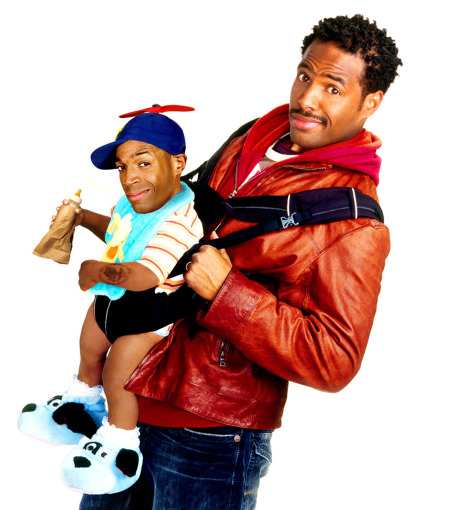
So now we have Little Man, in which Marlon W. plays the world's smallest cat-burglar, forced to hide a diamond the size of his head in the handbag of an upper-middle-class black woman. She's got a clueless husband (Shawn W.) who encourages her to accept the "baby" placed on their doorstep by Marlon's accomplice, the ever-more-disappointing Tracy Morgan. The "baby," of course, is Marlon-the-cat-burglar with a shave and a bonnet and a rattle. Apparently the short bus stopped at Shawn's house before Tracy came by with his bundle of joy, because the lucky young couple have no idea that the "baby" is actually a "grown" man, a midget diamond thief who only wants to get back his "booty."

(Please ignore my cheap and loaded fingerquotes.)

So we're supposed to accept that all the many HILARIOUS! situations that ensue tip neither Shawn nor Wifey to the fact that "baby" is "Marlon-the-thief." Okay. Alright. So even when "baby" is shaving with an electric at the bathroom mirror, smoking a stogie (that never stinks up the rest of the house?), offering his googly-eyed milking-face to the nearest set of tits (cue Benny Hill boob-music), and otherwise convincingly playing an infant WITH TATTOOS!!!, we're to assume that the audience are the only ones privileged with glimpses behind the curtain of the great and powerful Oz, as it were?

Does this kind of reprehensible trash annoy anyone else, or am I the only person this film has managed to piss off without so much as a viewing? Can't we all just get on the bandwagon and declare the damned thing a heresy without ever seeing it?

I have, and I don't feel the least bit guilty about condemning this prisoner without a trial. No, because I saw the trailer. Right after United 93. Those two minutes hurt me in my most private, most American parts. And I wish this film the fate of a criminal, a terrorist, a foreigner locked away without warrant at Gitmo. If only...

Okay, I'm angry. Perhaps irrationally so, but I'm still angry. After all, I'm more than willing to believe that men in capes can fly and dodge bullets and otherwise kick ass, but the idea of Wayanses mugging as midget diamond thieves upsets me in ways I'm not sure I can fully describe. I know it's a trivial pursuit, bashing Little Man, and I should be above raising any debate involving what is most likely a ludicrous steaming turd of a movie. Its quality (or lack thereof) should speak for itself, and there is no reason to expect Little Man will be remembered. Only the most important (or popular) films of any given year survive the passage of time, and I have no doubt that this blip on the monkeyshit radar will go down in history by not going down in history in the first place. When the next thing after DVD comes out, you won't be able to find Little Man in the new format at your local rental house. Mere words are meaningless when one attempts to convey the insignificance, in the grand scheme of things, of a film such as this.

And still it manages to raise my hackles. When this execrable piece of filmmaking makes it to a video shelf, it might sit alongside such underrated classics as Little Big Man and Little Man Tate. Ouch. Ugh. You have no idea how much it infuriates me to even grace this film with a post. Can you imagine what it feels like to know that anyone Googling showtimes for LM might wind up with my words bounding forth from the search engine? But I must. (Write about it, that is.) These thoughts have haunted me long enough. Little Man's very existence represents everything I hate about Hollywood and the machines that create our entertainments, and it's no laughing matter. I am writing this as a public service for anyone who might actually want to see the flick, for anyone who might be in a custodial arrangement with a child who thinks midget thieves posing as babies are funny. I hope the message hits whatever passes for home.

The trailer should be everything most reasonable individuals require to know that they should never see this film. Any introduction that warns "From The Creators Of White Chicks" should be more than enough forewarning for the conscious amongst us. But I will still wager an eyetooth (which ones are those?) and my weaker testicle that the opening weekend gross for Little Man will pass $20M domestic, which is probably more than enough to warrant, in Hollywood's dollarsign eyes, a sequel--or if not a direct follow-up, then at least another fabulous new witch's brew of Wayanses and CGI. The die is cast, and it has a little Marlon-face on every side. Do what you can to avoid the next roll.

Wednesday, July 05, 2006

This Blog Kills Fascists

In another of those weird confluences of time and fate, I've been listening again to the Mermaid Avenue albums around the time of this Independence Day. The estate and children of Woody Guthrie commissioned Billy Bragg, Wilco, Natalie Merchant, and Corey Harris to commit the late Woody's unfinished songs to wax (or vinyl, or plastic, as it were) during several studio sessions in 1997 and 1998. I can't think of a songsmith more fitting to ring in another year of our Strange American Democracy than Mr. Woody Guthrie. Was he a Socialist? Yes. A drunk? Okay. Generally an Odd Bird, and beautiful for the oddness? Absofuckinglutely.

Huntington's
had more than a bit to do with the last, and maybe something to do with the former. Who's to say?

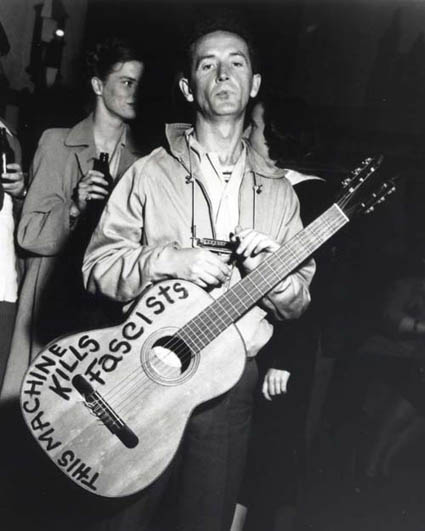
Most know Guthrie as the author of "This Land Is Your Land" and nothing else. The fact is that he spent his entire life crafting songs of rebellion, songs of unity, songs of putting democracy's tools in the hands of those folk who make democracy work. He also wrote offbeat odes to Hollywood actresses ("Ingrid Bergman"), gutwrenching love songs ("Remember The Mountain Bed," "When The Roses Bloom Again," and "At My Window Sad And Lonely"), strange quasi-Christian tunes ("Blood of the Lamb" and "Christ For President"), and ditties about the invisible people who have to clean up nasty-ass hotel rooms after people like us defile them ("Hot Rod Hotel"). He was a people's poet, the man who influenced Dylan and Baez and Arlo (natch) and pretty much everyone who's put pen to paper and guitar in the name of a cause since Black Monday, 1929. Think of him as the Bob Marley of our American Situation. It's not a stretch. He painted these words on his guitar, for chrissakes: "THIS MACHINE KILLS FASCISTS." Show me a person who doesn't respect that, I'll show you a person I'd rather punch than reason with. Ironic, no?

There's a great documentary the BBC put out detailing the creation of the Mermaid Avenue tapes called Man In The Sand. Check it out if you're interested. Hell, check it out if you're not interested. We owe it to ourselves as Americans to understand that which has--and those who have--come before us. The film and the albums are a hell of an intro. Besides being the most transcendently beautiful, utterly American albums in recent memory, they are a document of what our parents and theirs went through during the first part of the so-called "American Century," the Twentieth. Not so strangely, there is an echo of our modern future in Woody's Depression-era lyrics...

Take this snippet as an example, from "Stetson Kennedy":

"I ain't the world's best writer, ain't the world's best speller,
But when I believe in something I'm the loudest yeller.
If we fix it so you can't make no money on war, well
We'll all forget what we was killin' folks for."

Or this bit, from a piece Woody wrote for the People's World:

"Look like the ring has been drawed and the marbles are all in. The millionaires has throwed their silk hats and our last set of drawers in the ring."

Tell me that the man had an agenda, tell me his politics were neither red-blooded nor American, and I'll tell you you're not seeing clearly this sunshiney morning. But don't tell me that his words don't ring too fucking true in this current day and age. This was a man who served during the last clean war, WWII. He knew no Halliburtons, no Rumsfelds, no Bushes, no Wolfowitzes, no Nixons or Vietfuckingnams. Maybe we need another Woody, somebody with a love for this country so deep and objective, a love loved in spite of and for our shortcomings and blemishes, a love for the idea of America. In closing, a note on America and that love taken from a larger piece:

"Because I seen the pretty and I seen the ugly and it was because I
knew the pretty part that I wanted to change the ugly part,
Because I hated the dirty part that I knew how to feel the love
for the cleaner part,

I looked in a million of her faces and eyes, and I told myself there
was a look on that face that was good, if I could see it there,
in back of all of the shades and shadows of fear and doubt and
ignorance and tangles of debts and worries,

And I guess it is these things that make our country look all lopsided
to some of us, lopped over onto the good and easy side or over
onto the bad and the hard side..."

That middle bit chokes me up. Excuse me. Ahem. Right, so... Follow this link here for the full lyrics to "This Land Is Your Land." I guarantee it's not the same song you belted out in your fourth-grade pageant. If you feel the love, the fire, the anger, drop a comment and tell me how the same heat is relevant in our current global climate. Peace.

Tuesday, July 04, 2006

Blood, Fireworks, and Dollar Bills

[A few thoughts on this, our nation's birthday.]

Given the recent outpouring of philanthropy amongst our country's wealthiest citizens, I though it might be time to reflect upon the nature of giving of oneself, be that "self" seated in the soul or in the pocketbook.

Bill Gates recently announced he would be taking a backseat at Microsoft in order to helm his (and his wife's, because I guess half of it's hers) philanthropic organization. Shortly thereafter, Warren Buffett (no relation to Jimmy, and even richer) decided that he would one-up the estimable Mr. and Mrs. Gates by donating approximately $31 BILLION (give or take a buck or two) to their selfsame outfit. Cheers and huzzah to all parties involved, and long may they prosper in their do-gooding. Word.

Coincidentally (because this is how all these thoughts wind up happening), I also just finished You Shall Know Our Velocity!, by Dave Eggers. Mr. Eggers wrote a brilliant novel about two lifelong friends who decide to travel around the world in a week to give away $32K (US). Will, the main character, received the money for being on a lightbulb (read the book) and decided that he must give it away in the most extravagant, eccentric fashion he could contemplate. So he and Hand (his lifelong friend) hit Senegal and Morocco and Latvia and Estonia (though not in that order) and put obscene amounts of currency directly into the hands of the impoverished and deserving.

Will and Hand also decided to strap some cash to a goat with medical tape and a message bearing lightningbolts alongside a line from a Scorpions tune, but that is merely a sidenote. Again, read the book.

The whole "impoverished and deserving" bit is what YSKOV! is about, really. Charity normally takes the form of anonymous people writing not-so-anonymous checks to people who collect said checks (often during obscenely extravagant shindigs) and afterward set about giving the collected monies to deserving parties. Those parties, when the charity is done right, are impoverished and, indeed, deserving. Sometimes people skim, and sometimes charities must pay obscene amounts for the obscenely extravagant shindigs. Alas, such is all in a day's work of giving. But by going directly to the source, by handing out cash in person to the people who need and deserve it, Will and Hand subvert the normal architecture of charitable giving. Will's mom asks him at one point, via telephone, if he doesn't find his mission to be a bit tacky. She means to bring to his attention that handing cash to a person, fingers upon palms, removes the filter of anonymity and distance that most Westerners associate with charity. Surely there must be some guilt that changes hands along with monetary notes, right?

It's an interesting point. After all, when was the last time that you put a quarter in a homeless person's cup, or responded with anything other than eyes-ahead ignorance when a person approached you for cash on the street? Myself, I don't give to anyone in person. But it hurts me when I claim no change at curbside, and it hurts me to reflect upon my stinginess in the comfort of my air-conditioned apartment while I write these words. Will's mom has a point that bears mentioning here: which kind of charity is the right kind of charity, and what are the proper methods and means?

Not all forms of contribution to our fellow humans must take the form of anonymous donation. Were anonymity the key that unlocks our wallets, there would be no Habitat For Humanity, no Save The Children or the like. These charities thrive on the fact that they put a face on need, and that face is multicolored, multiethnic, multineedy. What Will and Hand set out to do is neither tacky nor ill-conceived, though their doubts are what make Eggers' novel great. Reading it made me regret not pitching a bit into the cup of a less-fortunate, not listening to the story of a person who may or may not be in need, withholding the odd smoke from someone with no means to obtain one. Sad, really.

So, in this spirit of giving that the anniversary of the birth of our (outwardly) democratic society puts me, I went out yesterday and donated blood. Sure, it's a somewhat faceless operation, all needles and iodine and t-shirts and weary smiles from your friendly local phlebotomist, but the posters on the walls of the donation sites feature the sort of people I might be helping with my pint of A-Negative. Kids with sickle-cell anemia, people who need a new liver, a new heart, a new pancreas, a new lease on the life I so often take for granted. It's a pleasure to help. It makes me feel good. It doesn't cost a nickel. And it shows how one little prick can help a few people in need.

Take that last comment any way you want.

Every charity, no matter how nameless or faceless it may seem, should eventually help someone with both face and name. That's what helps me sleep at night, at any rate. I hope I'm not simply naïve. Why don't we all get out there during this weeklong celebration of America's independence and help someone else achieve some degree of that precious commodity, independence. It doesn't matter how, when, where, or why you do it--just do it. If it's a dollar or a pint, a billion or a houseraising, give a little back this week in appreciation of everything we hold dear as Americans and human beings. Timeframes are no concern, so if you're reading this next week, next month, next year, get out and give. Every marathon, as they say, takes a step to start. Let today's be the first step of many, and keep the race moving. Peace.

Thursday, June 22, 2006

@#%&!

A couple of weeks ago I had the good fortune to watch the second season of Deadwood on DVD. This is how I catch most of my pay-cable shows, since I'm far too cheap (read: poor) to actually spring for the HBO. It's okay, though. Donations are accepted.*

Now, if you haven't been privy to the Deadwood thus far, it's the story of an illegal settlement in what is now South Dakota during 1877-78, a mining town devoid of law and/or order. The town was settled on Indian (Native American) land, without treaty, during a gold rush second (at that time) only to the 1849 strike at Sutter's Mill in California. Deadwood is a lawless town, not unlike many towns of the early American west, but this series marks the first time that such lawlessness and primal language, such utter disregard for civilization and its trappings (and yet, strangely, the attempt to hew civilization from rough stone, dirt, and gold ore) have been shown in any honesty to a viewing public. David Milch, creator and head writer of the show,** has a long history of putting questionable (read: potentially offensive and/or groudbreaking and/or envelope-pushing) material on television, a history that started with Hill Street Blues, on to NYPD Blue, and now he's accepted the opportunity to take salty talk back in time like a pottymouthed Doc Brown with a leather-chaps fetish. Huzzah to David Milch.

But it's the pottymouth I really want to talk about here. In the course of a single episode of Deadwood, one is treated to a plethora ("Si, Jefe, a plethora.") of Fucks, Cocksuckers, Fucking Cocksuckers, Motherfuckers, Cunts, Shitbirds, Shitbags, Shitferbrains, and Motherfucking Shitbird Cocksucker Cunts who may or may not have Shitferbrains. It's truly enlightening dialogue, people, and it's something we're not treated to everyday.

(Unless you work on an aircraft carrier. Or in a bar. But that's beside the besides...)

I also recently availed myself of the Netflix opportunity to see M*A*S*H again--the 1970 Robert Altman film, not the Alan Alda TV show. And, were it not for a spot that aired as an AMC promo for a subtitled-with-trivia airing of an edited version of Altman's film, I would not have known that M*A*S*H was the first (1970!) American motion picture to be released complete with an F-bomb. Amazing.

Nay. Fucking amazing.

Profanity is a strange, strange concept in this day and age. We are a country that has gone through a bloody revolution, a frontier-expansion period of Manifest Destiny that lasted (if you count Alaska) well into last week, gold rushes and industrial revolutions and union wars and Teamsters murders, two World Wars with a third on the way, and a major international asskicking in Vietnam, all of which must have had people saying something more profound than "Sugarbritches, I just got mama-effing shot by that...that...that dagblamed doodoohead." No. NO! Nonononono. That's not the way people talk. Life is not a Looney Tune, and nobody has ever really meant any utterance of "TarNAtion!" When their feet are to the fire, people cuss. Really cuss. Loud and often.

(Except for the Mormons. It's a well-known fact of anatomy that their bodies feature an outlet--not unlike an anus, though not as rosy-smelling--that blows every impetus for foul language out into the ether. I've also heard that rebellious Mormon children sneak into the trash bins at Salt Lake City Starbuck's-es to huff coffee grounds. It's sad, really, to see the brown stains around the mouths and nostrils of so many impressionable young inhibitionists. Sadder still to hear their half-hearted yet caffeine-riddled attempts at cursing through their angst. Tragic, even. But...)

I remember watching the first episode of Milch's NYPD Blue, way back before Zach Morris joined the show. I would have been fourteenish, and I remember Dennis Franz's Detective Sipowicz advising a female ADA to "Ipso facto this [grabbing crotch in handheld-camera closeup], you pissy little bitch." The partial female (and eventually--ugh--Franz-based male) nudity was cool, but mostly I remember the elation I felt hearing those words on broadcast television for the first time. These were words I heard my people using, but they were shocking in spite of the fact that they were an everyday and that I had heard them the Saturday night prior on SNL. Kevin Nealon was doing the Weekend Update, mentioned the fact that Tuesday night's NYPDB premiere would be the first show to air said words on television, therefore rendering the NYPDB's transgressions a tad bit late. Brilliant TV all the way around. Kudos fifteen years after the fact to all involved, should any of you be reading this. My heart goes out to all you bitches.

So Chicago Hope was the first primetime program to air the word Shit, and now it's on every episode of every show on FX (I like The Shield and IASIP, but I just don't get the appeal of Rescue Me***) and even a couple on TNT. Seinfeld (if I remember correctly) even aired a Son Of A Bitch or two during the last few years of its run. They definitely had an Ass in there at some point, and that show is the Gold Standard Of Class in my book.

A movie came out last fall called The Aristocrats, and its tagline was something like: "No Sex. No Violence. Unspeakable Profanity." We saw it at our local arthouse, and R.'s girlfriend A. walked out with 30 minutes left due to the aforementioned unspeakables. Let's allow her to represent Most Of America, while the other of us dirty cocksuckers (metaphorically speaking, here) shall represent Honest Americans Going About Their Entertainment. We sat through the entire film and heard the same unbelievably filthy joke told in numerous incarnations, spun out through various circumstances in an atomsmasher of filth and brilliance, and we laughed our pretty asses off for an hour and a half. Were we offended? No. Was A.? Abso-fucking-lutely. But what, then, was so horrifically offensive about the film? It featured an ages-old vaudeville joke, passed down through generations of dressing-cubicle-inhabitants and greenroom-junkies, that put the onus of a really nasty joke on the teller.**** The very thought of the joke (because the punchline, after all, is always the same) is the offense, as the joke's body changes like a shapeshifter from some much-more-offensive horror flick. And yet that very thought, it would appear, is enough to put a reasonably sensible girl into the lobby with two reels left. Strange.

One of Lexington's reliable local newscasts recently did a two-or-three night Special Report on the Power of Profanity. They claimed that Profanity is losing its power in our go-go modern world, where you can hear on television the same kind of filth you once had to join the Navy to witness. Must have been a slow news week. During one segment they showed a clip from The 40-Year-Old Virgin, in which Steve Carell's titular character screams out "KELLY CLARKSON!" while being waxed by a sadistic Vietnamese salon employee under the watchful glare of his friends. He didn't swear under the torture being visited upon him, and that was indicative of his stature as an uncorrupted male. Were he to have been a non-virgin at the point of his waxing, we might have expected something a little more colorful--if less creative--to have escaped his never-touched-pussy lips. But as it was, the news report used that clip as an example of how we can hope to curb ourselves of the cursing habit, how we can rid our mouths--if not our minds--of the filth that accumulates during lifetimes lived in Profanity's sewage-y wake.

But there's something to be said for Profanity, people, and I'll say it right now: It's Goddamned Mutherfucking Time To Legalize The F-Bomb In America. The S-bomb has already breached our perimeters, and we seem to be faring just as fucking poorly with, as without it. We live in an entertainment-driven society, a society driven by visions of brutality, violence, and anger that seem to be exempt from the rules we place on simple words. You can't say some shit on broadcast television, for instance, but you can show every form of sensational bloodthirsty childraping bodydesecrating whoreslicing gunshotbleeding vengeancekilling traumasurgeoning violence on any show named by abbreviation. Just look at Law & Order, L&O SVU, L&O CI, CSI, CSI:NY, CSI:Miami, ER--and that abbreviation rule excludes shows like Criminal Minds, Medium, Ghost Whisperer, Crossing Jordan, Cold Case, Without A Trace, Numb3rs, and every show like them that's not on the Big Four. Hell, take it back to any other example that's no longer on the air. On television as in film, there is plenty of wiggleroom when you're selling violence, but none when it comes to the profanity that such violence would seem to warrant. Are there simply very urbane, very civil crime victims out there that these shows have found and exploited? Or do we live in the midst of a vicious double standard that rates a heinous act lower than a dirty word on the big totem pole of propriety?

Yes, this society is still fighting its way out of the arms of the Puritans. Yes, this society is still figuring out a place in the world that doesn't involve colonialism on our part or another's. Yes, this society is fighting yet another nonsense war with spurious justifications. We should be angry, people, and we should be able to voice that anger and hear it voiced. Fuck a bunch of "Profanity." It's the trees, not the forest. We seem to be content watching all the manifestations of evil sold to us as entertainment, without any of the recoil, any of the moral encumberance, any of the guilt that should go along with them. We still live, for CHRISSAKES, in a country that won't let us see pictures of the 2500-odd flagdraped coffins we've flown home from Iraq.

And yet, somehow, you can't say "That's a fucking travesty" without drawing dirty looks from the parents of young children nearby, parents whose four-year-olds will eventually wind up the victims of IED's on the streets of Baghdad, or Teheran, or wherever we have to go next for oil.

That's fucked up. I hope you agree. If not, please take a flying fuck at a rolling doughnut. This is America, after all, and I can tell you to take a flying fuck at the moooooooooon. But be well and take it light, as your opinion is as good as mine.

Peace.

*: In unmarked bills (the larger the better) or checks made payable to "Cash" or "The Human Fund: Money For People." On second thought, let's just stick to the unmarked bills.
**: Third season currently airing Sunday nights at 9 PM (EST) on HBO. The fourth season has been sadly truncated to two two-hour specials set to air at some point in the next decade, or just way-the-fuck-after whenever they get around to filming them. Sopranos fans, you know what I'm talking about.
***: Ironically, even given the freedoms of language I'm talking about in this essay, Denis Leary seems to be pulling punches when he's not swearing more extravagantly.
****: Or, more appropriately, Penn (also the director).

Thursday, June 08, 2006

Demonspawn, Bitches! Horror's New New Wave

Not to jinx it so close to its finish, but we're almost through the Week of the Beast without the world ending, the rivers running red with blood, or cats and dogs playing together. No mass hysteria, no comets or plagues or anything like that. Phew, right? [Pause to wipe nervous sweat from agnostic brow.] What a relief.

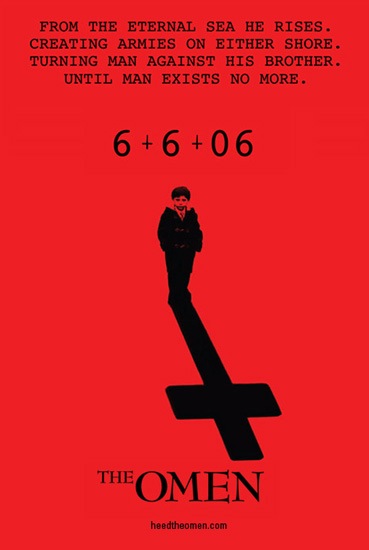
Tuesday was officially the epicenter of the WotB, its date (if you're given to such flights of imagination and are wont to drop the occasional meddling zero) ringing hell's bells with its trifecta of gonghammer sixes. And, of course, Tuesday also marked the release of a new take on Richard Donner's* 1976 classic, The Omen. As marketing ploys go, it was an unmitigated success. As films go, let me put it this way:

Had the world ended on Tuesday, had the Beast decided that now's a good time to run amok, twelve-million-dollars-worth of American moviegoers could count seeing the remake as a weight on their eternal souls.** Thank heaven (?) Satan is leaving all the destruction, terror, and mayhem to God these days. Beelzebub has realized it's best to stick with what he knows. He usually just does what comes naturally, laying low until the next Republican needs a slim margin in a major election.

But all that's sort of beside my point, which is this: isn't it strange how the newest thing in horror movies is creepy/haunted/undead/demonspawn children? We seem to have come full-circle from the time of the original Omen, passing through a wave of slasher flicks focused almost exclusively on teenagers and their value as hyperhormonal chainsaw fodder. What happened all of a sudden?

(Technically, the official first entry of this particular brand of horror flick would be Rosemary's Baby, Roman Polanski's 1968 chiller. That film featured Mia Farrow being impregnated by a hairy beast of a Beast in a truly ugly nightmare-rape sequence. Rosemary is the unwitting participant in the proceedings, her husband having sold the Friendly Local Coven a 9-month lease on her womb. See the flick to find out how it all ends, but watch it with the lights out. Really.)

Six years after Rosemary gave birth to Satan's lovechild, the slasher flick was already terrorizing America's teenage demographic. That was the year Tobe Hooper's The Texas Chainsaw Massacre gave rural Texas a REALLY bad name. A little later, in 1978, John Carpenter set deranged manchild Michael Myers*** loose on teenagers celebrating Halloween. Two years after that, Jason Voorhees terrorized Camp Crystal Lake (and Kevin Bacon) in Friday the 13th. And in 1984, Freddy Krueger planted his flag in the dreams of a generation (and Johnny Depp, for one more pop reference) in Wes Craven's A Nightmare On Elm Street. All of these movies spawned legions of imitators and countless sequels, but not until Scream signaled the slasher-flick's demise (by going totally po-mo on its ass, before ironically falling into the same dead-eyed cycle of rehashings it originally sent up****) did the new new thing in horror drift across the Pacific in a fog-shrouded ghost ship from Japan.

(Pardon that image. It's not accurate. It was actually a fog-shrouded FedEx jet that delivered prints to film festival screenings populated by really hip devil-worshiping zombies cloaked in torn black parkas. On skis. In Utah. Anyway...)

With the rise of the Japanese horror (or J-horror) film in the mid-90's, Hollywood discovered that it was lagging sadly behind the curve of what people really think is scary. The slasher flick had grown bigger than its genre, to the extent that decapitations and dismemberments (ad infinitum) just weren't putting asses in the seats anymore. Into the vacuum rode J-horror movies like Ringu (remade in America as The Ring), Ju-On (The Grudge with Sarah Michelle Gellar), Kairo (this summer's upcoming Pulse), Gin Gwai (technically from Hong Kong via Thailand, but slated for a 2007 remake as The Eye), and Honogurai Mizu No Soko Kara (a mouthful, and the source of 2005's Dark Water). Instead of focusing on the exploits of a superhuman, undead/undying villain (a la Jason or Freddy), these films' "villains" are almost always ghosts seeking to right the wrongs done them in life. There are conclusions despite the evidence of sequels. These films were breaking box-office records overseas while setting the new standard for horror films on other shores. And, not surprisingly, Hollywood has been playing catch-up ever since.

(A quick thought on foreign films in Hollywood: nobody would think about "re-envisioning" The Seventh Seal or 8 1/2 or The 400 Blows. That would be taboo, right? For chrissakes, Gus Van Sant was almost--deservedly--crucified for his shot-by-shot take on Hitchcock's Psycho, and that was a Hollywood flick to begin with. But for some reason Japanese cinema has given us a different rule when it comes to remakes. Akira Kurosawa's The Seven Samurai and The Hidden Fortress became The Magnificent Seven and Star Wars, respectively. And the kitana blade cuts both ways: after all, Kurosawa's Ran was an Asian appropriation of Shakespeare's King Lear. In the aforementioned J-horror case of Ju-On, the Japanese version's original director, Takashi Shimizu, was hired to helm the fucking-up of his own work for Japanese-owned Sony Pictures Entertainment. There's no mystery here, I guess, and I'm not calling for remakes of everything that comes across the A-pond out of some botched notion of equal time. I know that Cash Rules Everything Around the Hollywood Mainstream [CREAHM--get the money!*****], and nobody packs the house for an Austrian like Michael Haneke and his horrific excavations of the human psyche. I'm just saying.)

What each of these J-horror films has in common, besides any Asian origin, is that they all deal somehow with very young children as the perpetrators (or victims, but usually both in that case) of the horror.****** I won't go into any greater detail here, so as not to further bore all of you senseless with my reductive analyses of each film's storyline (get Netflix). Suffice it to say that the goings-on are supernatural in nature, taking the form of beyond-the-grave reprisals for the horrors visited upon children by the adults in the films. Young children represent a raising of stakes within the world of each film, an embodiment of vulnerability and dependence that, once betrayed, leads to otherworldly consequences. But instead of focusing on the exploits of a superhuman, undead/undying villain (a la Jason or Freddy), these films' "villains" are ghosts (and very young ghosts, too) seeking to right the wrongs done them in life. The element of mystery is key to J-horror, and the plotlines usually trace the unraveling of knotty circumstances surrounding the death of an innocent. That being said, and despite the evidence of sequels, the films conclude when the mystery is solved and some form of justice is meted out in the ghosts' names.

So there's a theory out there that every turn in the recent winding history of the horror movie serves as an onscreen portrayal of a society's most potent fears. The American horror flicks of the 1950's (check out Invasion of the Body Snatchers) were thinly veiled allegories of Cold-War paranoia, when even your neighbor (or his alien double) might be the guy who sells the Russkies the Bomb. Zombie movies (at least since George Romero's 1968 Night of the Living Dead) were thematically related, but on the other side of the divide. During the Vietnam-protest counterculture of the late 60's, the zombies were stand-ins for the military-industrial-political complex and every voter unhip enough to support it. Slasher flicks of the late 70's and 80's, which on the whole punished their victims for exploring their sexuality, reflected a strange, seemingly conservative expression of "sex equals death" in a bid for the post-sexual-revolution wallets of the wealthiest teenagers in America's history, the Baby Boomers' children. Later examples of the same genre (especially Craven's Nightmare and its sequels) can be read as early echoes of the AIDS crisis, when nobody knew if their wet dreams might cost them their lives.

The American horror flick experienced a brief denouement in terms of social relevance during the late 80's and early 90's, evidenced by trash like the Leprechaun series, Child's Play and its sequels, and latecomer goofs on Stephen King novels. Only recently has the genre revived itself, ushering in a new wave of American slasher flicks like Eli Roth's supercreepy Cabin Fever and Hostel, and recent big-budget remakes of The Texas Chainsaw Massacre (prequel coming this fall) and The Hills Have Eyes. These films owe a great debt to their predecessors in the slasher genre, but their human (if inbred, European, and inbred/deformed--in that order) villains separate them from the Asiatic herd. This American new wave--set apart in tone and content from the J-horror remakes that have flooded the American marketplace around them--are essentially revenge pictures, and have been interpreted as gory ruminations on post-9/11 America and our War on Terror. They are the cinematic expressions of "Let's roll," "Put a boot up their ass," "These colors don't run" and any such jingoism. A couple of them are also genuinely frightening.

During American horror's stagnation, the Japanese were churning out the precursors to the J-horror flicks to come. The animated films of those years (especially Urotsukidoji [Legend of the Overfiend, 1989] and others like it)--while not quite horror flicks, per se--were not wholly, thematically different from American post-WWII horror flicks of sabotage and Commie infiltration. The Manga films showed the first genuine emergence of a fantastical post-nuke paranoia wandering through that country's popular imagination, forty years after Hiroshima and Nagasaki, and the forms that filmic paranoia took are astounding for the grandeur of their oddity. Just look at Urotsukidoji's promotional art [DVD cover pictured], at the mushroom-cloud of light on the Overfiend's chest as he prepares to devour an entire cityscape. Dominated by a famous scene featuring an army of fifty-foot sperm ransacking a hospital in search of impregnable human females, Urotsukidoji stands in testament to a nation and a people still reeling from the brink of nuclear annihilation, still dealing with the collective memory of millions scarred by radioactivity, fear, and loss. Until Russia (Ukraine now) releases anything similar twenty-plus years after Chernobyl, those Japanimation flicks will remain some of the scariest feats of human imagination in the wake of real, personal horror.

So what of this new new wave, then, the J-horror flick? Whether or not (or until) they're bastardized by Hollywood, these films have acquired rabid followings, spawned numerous sequels, and show thematic similarities that can't be coincidental. The ghostly kids, the omnipresent water imagery, the spooky posthumous vengeance, et cetera. And what is it with the children again, all of a sudden? Thirty years after Donner's The Omen, its remake comes out (scripted by David Seltzer, the same man who wrote the original) on 6/6/06, following what have been bumper crops of J-horror remakes that have tilled similar (if not Satanic) territory. Is it simply a glitch of the marketplace, a déjà vu of sorts during which Hollywood attempts to cash in on shit that other folks are doing with more panache? You be the judge. If CREAHM ain't the reason, I sure as hell can't figure it out. Maybe this is globalization in action, and the Japanese are outsourcing their horror-flick ideas like we do helpline operators to Bangalore. It's a mystery at the moment, but perhaps one that will find its solution (and valid interpretations) around the corner. Until then, as long as they aren't serving it up raw (sushi horror?), the kids in Middle America are sure to eat it up.

*: Now that I think of it, Donner's having a bit of a rough summer. Along with the pointless remake already mentioned, his 1978 Superman is also getting a coat of polish (and maybe some manscaping) from Bryan Singer's Superman Returns. Next we know they'll be giving us a remake of Lethal Weapon--as if all three LW sequels, 16 Blocks (also Donner's), Training Day (sorta), Kiss Kiss Bang Bang ('cause gay is the new black?), Die Hards I, II: Die Harder, and With A Vengeance, and Rush Hour plus two sequels (one done, one upcoming--maybe Chinese is the new white?) hadn't already run the mismatched-buddy action-comedy into the fucking ground.
**: In the interest of full disclosure, I was $5.25 of it. BTW, it sucked devilnuts.
***: Not to be confused with Mike Myers, whose recent lack of funny is even more frightening. Lose the no-longer-hilarious Scottish accent, Mike, or I'm gonna forget both the original Wayne's World and the first Austin Powers. Don't test me, bitch. It's been a long week.
****: You know your franchise has jumped the shark when a spoof comes out to spoof your spoof. To wit: Scary Movie, which, not really coincidentally, just released its fourth installment. I'm not even sure how to itemize the ways that franchise has tripped over its own limited cleverness, but I'm pretty sure it has something to do with a Wayans brother. Or maybe a Sheen.
*****: Dollah dollah bill, y'all.
******: Kairo (Pulse) is the lone exception, since every rule needs one. Still, you get the point.

Friday, May 26, 2006

Random Friday: Memorial Weekend Edition

[Wherein our hero posts a collection of queries, ponderings, and dubious trivia to clear his mind for the long weekend ahead. A happy holiday to you all, and remember: a good BBQ is a safe BBQ.]

Benjamin Franklin's suggestion for the official bird of the new United States was the wild turkey. One of the great man's few missteps, it led to an unsuccessful bid at suicide-by-electrified-kite.

McDonald's
is running a new commercial in which two coworkers are sharing lunch. One warns the other--who is eating a chicken sandwich from the Arches--that if he keeps eating chicken sandwiches he will turn into a chicken. In one of the darkest turns ever witnessed in a fast-food spot not featuring the Burger King, a Kafkaesque metamorphosis takes place in subsequent scenes as the man, indeed, begins to resemble a chicken. (In one shot, there is a fox in his hallway eyeing him with hungry fox-eyes.) Not shown are the scenes portraying the transformation of the burger-munching co-worker into an inambulatory mound of unprocessed soy filler, torn cowhide, minced hoofparts, and rat excreta.

With bleary, dead, rueful eyes.

Foxes are renowned throughout the animal kingdom for possessing the largest vocabularies of any four-legged beast.

The polar bear is a close second, though their habit of devouring rapt listeners has led to the species' largely oral history becoming shrouded in mystery and speculation.

While most hippopotami never learn to read or write, they are acutely aware that their name derives from the Greek (via Latin) for "river horse." Neither the hippos nor this observer are quite sure what the Greeks were thinking there.

Seriously, though, what's up with the Yeti? You just don't hear from 'em as much as you used to.

Upon his abdication of the English throne, Edward VIII embarked on a brief but lucrative alt-porn career under the pseudonym "Li'l Eddie, Lord Fucking-Hand." No copies of his work survived a direct hit during the Blitz, though Hitler, ironically, was rumored to have been a fan. The loss of the negatives filled the Nazi leader with his only regrets of the Second World War, and led to a debilitating period of self-doubt fueled by schnapps and tearful autoerotic asphyxiation.

Most common euphemism for masturbation [American English]: "spanking the monkey."

Least common euphemism for same: "tap-dancing with Ernie Borgnine."

Number of times it looks like Borgnine might make out with William Holden in Sam Peckinpah's The Wild Bunch: 7.

Number of times he actually does: 1. The scene was deleted from the original theatrical release, though sources hail that long-lost clip as a brilliant (if whiskey-soaked) deconstruction of Wild West machismo that paved the way for future gay-in-the-saddle epics like Brokeback Mountain.

Is Borat [at right] wearing a man-thong stretched to the limits of Lycra, or a woman's bathing suit sold by hateful French shopkeepers?

Either way, Borat, nice shoes.

Thursday, May 25, 2006

Soul-Sucking Mediocrity Reaches New Heights

During its fifth season, I managed to catch a collected twenty-odd minutes of "American Idol." And, unsurprisingly, I feel in need of a long shower and perhaps some creepy-albino-monk self-flagellation as penance. Fifteen of those minutes were during last night's season finale, a cavalcade of truly incomprehensible D-list cameos and unforgivably overwrought suspense-mongering on the part of the show's hosts. In the end, it appears more teenage girls with cell phones wished Taylor Hicks were their grandfather than wanted to be Katharine McPhee. The zillion people watching the events unfold live (as we were ceaselessly reminded by the elfin Ryan Seacrest, as if it mattered?) were treated to McPhee performing a duet with Meat Loaf, and to eventual Idol Hicks leading a well-preserved Dionne Warwick around the stage during a not-exactly-all-star rendition of "That's What Friends Are For." The girls and guys evicted from the beach house (different show?) during the past few months returned to show us their pop-medley skills, and 5-watt luminaries like Tori Spelling and a teary David Hasselhoff beamed from the audience during random, irrelevant cutaways from the musical irrelevance unfolding onstage.

Oh, and apparently Prince showed up to cash in the last of the goodwill I was holding for him. I missed that part of the evening's festivities, but I've spoken with his people (all of them equally tiny and well-coiffed, like there's a factory somewhere) and we reached an agreement. I get to keep my copies of 1999 and Purple Rain for all purposes not karaoke, and he never shows up on any jukebox within 500 yards playing anything recorded after the Batman soundtrack. The "Diamonds and Pearls" video is still being contested.

And these were the highlights, mind you. The rest of the show consisted of getting in some final jabs at the most interesting (in the Chinese sense of the word) auditions from the season's first half. Seacrest awarded a handful of horribly misguided kids for publicly butchering the work of the world's most mediocre pop stylists. These segments were introduced with the revelation that "AI" has been overlooked at every TV awards show during its run (thank you, Emmy), even though more people voted during Tuesday night's final showdown than have voted for any American president, ever. Not coincidentally, the latter observation was also the hook for the recent film satire American Dreamz, which I didn't see (but kind of wanted to) because that introduction was simply too damned depressing.

To make a long story short, I just don't get it. Sure, every season is one prolonged exercise in test marketing and product packaging, and there's a long list of manufactured pop acts whose successes were just as calculated as any Idol's. But the irrepressible, stomach-turning earnestness with which these kids (and Hicks) belt out the tiredest, schlockiest, most meaningless pop drivel is enough to drive any conscious observer absolutely fucking batty. Most of the execrable tunes to which the show's assorted performers time their histrionics and vocal flourishes would be cause enough for any member of the target demographic to change the radio station. Even with that fact in mind, however, the kids evidently love hearing dutifully observed covers performed by nobodies backed by the obligatory pop orchestra and gospel choir. I mean, "(I've Had) The Time of My Life?" How anything so predictable and yet so utterly left-field and dated can make the teenyboppers scream is a mystery to me. If you've got an explanation, I invite you to leave a comment at the end of this post.

I know we need our distractions in this frightening modern age, a moment defined by foreign wars predicated upon lies told by shadowy, duplicitous powers-that-be. It's not that I don't understand the popularity of contest programming, which is as old as television. And I get the appeal of witnessing talent plucked from obscurity, an undeniably American dream that drives countless youngsters to seek fame and fortune on the silver screen and the 45. But for my part, hearing Hicks shout a victorious "Soul Patrol!" after being crowned was puzzlingly embarrassing, and not only because I have no idea what the man was talking about. Based on what I saw, I'm not sure where to find the "soul" in his generic performances, and the fact that such a cheesy catchphrase could drive the proceedings filled me with cringing embarrassment, not entirely unwarranted, for everyone involved. Oh, and I'll have to boil my culture-snob eyeballs in bleach to rid them of the slo-mo footage of Hicks and Seacrest writhing on their backs like upended turtles during a gratuitous end-of-show montage. While conducting these necessary ablutions, I'll probably turn on some real pop idols singing their oddest works, like "Maxwell's Silver Hammer" and "Rocky Raccoon," just so I can remind myself that unpredictability and unfathomable, universal popularity can coexist. You can have your Idols, America. I'll stick with The Beatles.

Monday, May 22, 2006

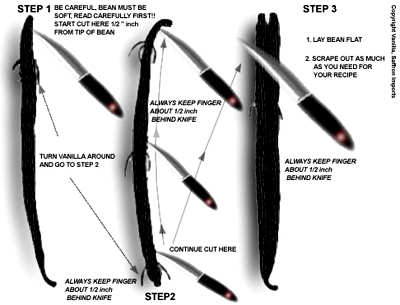
Disco Vanilla Trades In Her 8-Tracks

So there was this Pepsi (or was it Coke?) commercial a while back that featured two trucks, one from each competing sugarwater purveyor, driving alongside each other down the road. At a stoplight one driver flips a switch, shows the other what kind of system he has thumpin' in the rear of his freight-haulin' ride. A moment passes, then the other driver flips his switch. His truck's side panels open to reveal not a truck full of soda products as one would expect, but many stacks of concert-gauge speakers running heavy on the bass end. The sound from the latter truck dwarfs that of the first, and then the whole second rig starts bouncing on hydraulics. Slogans run in the foreground thereafter, proclaiming the latter pop company's vanilla cola to be less "vanilla" than their competitor's--a strange tactic, given that they're selling, after all, vanilla cola.

Now, I'm fully aware that I might be a year or three late with this somewhat reductive analysis of the Vanilla phenomenon. I even had a professor last semester who asked his class if we weren't responding to Henry James' "The Turn of the Screw" because it was too, well, "vanilla." If that's not sure enough a sign that a pop-culture reference has jumped the shark (as the very term "jumping the shark" did about two weeks after the website reared its cyberhead), I'm not sure what is. But hear me out, people, because there have been Interesting New Developments in Vanilla.

Such a proclamation may seem a contradiction-in-terms, but let's look at the evidence. After that initial product introduction (wasn't it a Super Bowl commercial?) there have been a slew of newer variations on the Vanilla theme. There are now cherry-vanilla carbonated beverages, and diet-cherry-vanilla, and raspberry-vanilla-crème (not cream, mind you, but crème--how fancy and urbane!). No less a pitchman than Emeril Fucking Lagasse has shown up shouting "BAM!" from the mountaintops as he sings the praises of Crest Vanilla Mint Whitening Expressions Toothpaste. And where would Vanilla be without her kinda skanky, semi-retired, tarted-up whore of a second cousin, French Vanilla?

(On that note, what is French Vanilla, anyway? Why is it more beige than white--is it egg or something? What makes it "French?" Are there little French kids in an ice-cream sweatshop (?) somewhere doing something more interesting than Breyer's original, plain ol', see-those-vanilla-bean-shavings-that-means-it's-real-vanilla vanilla ice cream? Ahem. I digress.)

The thinking behind the new usage of "Vanilla" is quite obviously racial in overtone, with undercurrents of class instability and a lingering palate of white guilt on the finish. The marketers would have you believe Vanilla is whitebread, WASP, Middle-America, Plain Jane. Vanilla is all "Ahoy, polloi," sporting topsiders and linen pants at the yacht club's cocktail hour. Vanilla has lawn jockeys in the front yard ever since the subdivision council outlawed pink plastic flamingoes, and it doesn't see anything wrong with that. Its darker counterpart in the Neapolitan scheme-of-things (disregarding Strawberry, which is Switzerland in this debate), Chocolate, is the new new thing, the yin to vanilla's yang, the hot new hip-hop shit for the 2K6, even though it's been the same old-school Chocolate for ages untold. Vanilla, it seems, is too old to even be old-school. It's the sockhopper at the Wu-Tang show, it's the moustachioed cops who crash the house party and actually inventory the confiscated weed. Vanilla is the bowtied guys in the Beastie Boys' video who offer soda and pie to all the partygoers who never fought for their right.

To paaaar-tay.

So why, then, does Vanilla seem to be making a comeback in spite of all the aspersions cast her way? Granted: she gets all dressed up in the newest rags, and she's had some surgery to correct both the overbite and the saggy neck, but isn't New Vanilla in the miniskirt and CFMP's just the same old hag with an Extreme Makeover? Why is she worth the bother of Vanilla Mint, Vanilla Crème, Vanilla Raspberry Cherry Swirl Delite? Is there something about Vanilla worth saving?

Apparently the answer is a resounding "YES," at least if you're listening to the marketers who bring the old girl around even while they talk nasty about her to their friends. Sure, New Vanilla's an easy lay, but it hasn't always been that way. She's suddenly willing to try different things, and you might even get her in a three-way with your buddies Minty and Razz (you might even take her Cherry!). It appears that Granny Van is actually hipper than you would think, and the advertising dollars are there to make sure you know it. Maybe Vanilla is the new Chocolate, which--for all its hipness-by-omission, at least in terms of the Vanilla discussion--hasn't seen much in the way of experimentation since the Andes Mint and Cookie Dough ice cream. Not that it's needed any work, mind you.

(But speaking of, doesn't "Chocolate Chip" sound like the nickname you gave your douchebag cousin who played Young M.C. while trying to gouge you for shitty weed when you snuck away from the aforementioned yacht club soiree? Wasn't he just one dirty little chip of wackness in a huge fucking tub of Vanilla?)

It bears noting here that most of New Vanilla's work is hardly worth writing home about, and that's not only because of all the kinky shit she's getting into. Like any good relationship, she's easy to fuck up when you're too busy focusing on other things. So much attention is paid to the dressing-up that somebody seems to have forgotten what Vanilla tasted like in the first place. Strawberry and Chocolate seem to have survived just fine, even when you consider the execrable examples to which they lend their names. It's strange, really, how the simplest experiences are those most easily fouled-up and watered-down. But back to Vanilla. Emeril's much-BAMmed-about toothpaste, for instance, tastes like somebody spat a full swig of Scope mouthwash on a lousy off-brand sundae. Vanilla Coke and Vanilla Pepsi taste about the same (regardless of the creative advertising and dueling cola-hoopties), which is to say that they're nowhere near as good as a fountain soda of either brand with a shot or two of real vanilla syrup. And as for whatever Dr. Pepper thinks he's doing with Vanilla and every berry and cherry hanging from the tree, my prayers are with his patients during this time of misguided distraction.

In the end, I guess there's only one thing we all need to remember: no matter what the corporations who sell us our Things try to throw our way, the best New Shit is almost always the Old Shit. New Vanilla will get busted eventually for working the wrong corner, either by the cops or by some newer, flashier flavor with a razorblade under her tongue and some turf to claim. Old Vanilla will always be right there for us, waiting beneath the cap of an ice-cold IBC Cream Soda. She was born in 1919 and she's had her fair share of bumps in the road, but she's still one of the finest Vanillas this impartial observer has ever enjoyed. Wrinkles and all.

Monday, May 08, 2006

Loose Associations on a Theme

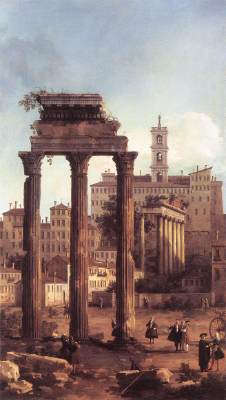
I told Murray that Albert Speer wanted to build structures that would decay gloriously, impressively, like Roman ruins. No rusty hulks or gnarled steel slums. He knew that Hitler would be in favor of anything that might astonish posterity. He did a drawing of a Reich structure that was to be built of special materials, allowing it to crumble romantically--a drawing of fallen walls, half columns furled in wisteria. The ruin is built into the creation, I said, which shows a certain nostalgia behind the power principle, or a tendency to organize the longings of future generations.

Murray said, "I don't trust anybody's nostalgia but my own. Nostalgia is a product of dissatisfaction and rage. It's a settling of grievances between the present and the past. The more powerful the nostalgia, the closer you come to violence. War is the form nostalgia takes when men are hard-pressed to say something good about their country."


--From White Noise, by Don DeLillo

The Alamo, 1999

It seems like just a little old building, and I guess that's all it was. Is. For some reason I expect John Wayne and a coonskin cap, maybe Jim Bowie or Sam Houston as Disney animatronics telling us about the history of the Little Church That Didn't. For a famous last stand it seems oddly placed near the center of downtown San Antonio, close to a Riverwalk I remember from a strange mid-80's Dabney Coleman flick called Cloak & Dagger. We smoke a bowl in the car and have massive cheeseburgers at a chain restaurant featuring a full side of beef hanging in a windowed butchery at the entrance. Once finished with our half-pounders we get back on the road, back to New Orleans, passing along the way a pickup truck loaded with random wooden frames and cushioned furniture. A Tex-Mex father and son grin and wave at us from the loveseat situated cabside in the truck's bed. The father's longish hair blows down on his forehead before he sweeps it back, an effort in vain riding backwards at 80 mph, as he sips intermittently from a paper bag.

Wrigley Field, 1992

The moms bro sis and I are sitting on the third-base line, watching Ryne Sandberg and the Cubs beat the Astros. My sister claims Sandberg as her favorite player, but given that she's a girl and he's one of my own favorites, I assume H. is just trying to keep up with her brothers. It's my fifth or sixth Major League game, the first that doesn't feature the Cincinnati Reds playing at Riverfront. I can smell the Old Style steaming off the skin of the men in front of us, sick-sweet and maybe a false memory. The famous ivy on the outfield wall is too far away to bear any significant odor, but it looks like it smells green, like fresh money or the hide of a lime rhino. My brother and I try to get into the outfield bleachers late in the game, on an ivy-smelling sensory expedition all our own, and are stopped at the entrance by a man asking for tickets. Wrigley sells out, it seems, even in the early afternoon on a weekday. We walk back to our assigned seats under exposed pipes, big enough to fit a man and hanging fifty feet in the air, as the streetside sunlight cuts visible swaths through the steam rising off every Polish sausage stand.

Keeneland, 2006

Ten years have passed since I last visited the track on a Friday-afternoon bailout from high school. This time around we are old enough to drink overpriced beer and syrupy mint juleps bearing only a name in common with any proper execution of the cocktail. We sip and talk and laugh and bet and lose, though not necessarily in that order. An early morning's jump on the afternoon garners the industrious (we are not among them) a prime seat on the paddock green, a place to throw the blanket, park the cooler, claim a small tract of Bluegrass in the name of whichever sovereign one might choose. Kings Miller and Budweiser rule the day. After the simulcast Derby ends on the Jumbotron and we throng out to the rolling parking pastures, anyone near the fourth turn has a view of the jumbo jet parked at the airport across Versailles Road, the flag of the United Arab Emirates emblazoned on its tailfin. Some sheikh or sultan must have named Lexington the stopping-off point for his bulletproof limo on the way to Friday's Oaks and the big race on Saturday. I wonder if our racetrack's gables and cupolas are visible from the jet's port windows.

Gulf Shores, 2001

Due south of G.S., on a sandbar that might not exist anymore, I'm walking in a stiff, salty breeze with a girl I don't even know. It's past midnight and we're both naked to the waist. Three hours previous, I liberated a bottle of fine German doppelkorn from my workplace and hopped in a beater Saturn with a mysterious brunette and an obese, epileptic golden Labrador. I have known the girl for a week and the dog for the three-hour drive. The girl and I walk, we talk, we drink from the bottle while her dog barks at the surf. We eventually make it back to her family's place on the beach and she promises me we'll go crabbing in the morning, maybe take the jet-ski out on the lagoon side of the sand. We're lying on the couch later and she tells me she's been studying a little shiatsu, asks me to lie back in her lap. She applies a dime's weight beneath her fingertips upon my temples, my earlobes, under my chin, and we both fall asleep listening to the stereo's dying gasps of anonymous jazz. I awake with a start hours later, turn around to find her still sleeping, carry her to bed. We spend the morning doing what people do, disregarding the shades' arrhythmic flapping in the offshore wind.

Bled, 2005

Staying with some newfound friends in Slovenia, I hop a ride to a tiny subalpine lake in the Julian Alps. My guidebook tells me a tiny island in the middle is home to a chapel with a bell that grants the ringer seven years of good luck. So we go to the lake, and we dive from the pier, and we swim the kilometer across to the island, and we walk up the stony path leading from the shoreline to the chapel. And when we get to the chapel, my friends--both Catholics--tell me they'll wait for me in June's diamondbright sunshine, out of a reverent deference to God and to the signs posted that outlaw the entrance of anyone in swimming shorts and bare feet. They leave to me any decision to transgress upon what might be God's own law, in God's own house, on a foolish quest for some rumored modicum of good fortune. Possessing no belief in any divine being, yet ironically possessed of a desire for the divine benefits of said bell-ringing, I scamper into the chapel and jump as high as I can, grabbing the rope and pulling it down with all my weight. When I land again on the stone floor, I leave little wet toeprints behind me as I hightail it out the side entrance. The bell rings for about a minute. As we swim back I'm nearly cut in half by Slovenia's local Olympic sculler knocking out laps in his razorboat. Every soda cap still reads "Please Try Again."

Canyon de Chelly, 2004

I begin the hike down the canyon's side to the White House at 7 AM, after a preliminary peanut butter sandwich watching the Arizona sunrise on the drive up. My camera bag holds three lenses and seven filters, my tripod rests on my shoulder, and my water bottle burbles in anticipation of a full morning's trek. On the way down I stop to photograph the whorls of sandstone on the smooth face of the canyon, trying to catch the alternating red orange yellow gold glinting in the morning sun. Dry desert air blows chill, not yet warmed beneath the rim as I follow the trail to the green canyon floor, onto the Navajo sheep farm where a sign is posted: "No Photographs Please Respect The Inhabitants And Pick Up All Trash." I see the sheep and two Inhabitants and I wave, but they don't even mark my presence. I continue across the bottom to the opposite cliff face, still in shadow awaiting the afternoon's sun. As I look up at the 800-year-old Anasazi ruin, I notice the Native American couple bowing and kneeling at the chain-link fence that separates tourists from the cliff dwelling. The couple are keening, a term I mentally apply to their singing supplications although I know it only from an Irish play I read and forgot years ago. Perhaps they're merely praying. I sit forty yards behind them for thirty minutes, maybe more, when a French family comes singsonging down the trail behind me. We are the only four people in that part of the canyon who have no right to be there, and I hold up a hand offering a universal stop sign, SVP, merci. They cut their conversation tout court and sit with me in the dust. We wait, silently, for words we will never understand to finish echoing from the ancient home with "Adams US Cav 1879" carved into its otherwise still-white façade.

Wednesday, May 03, 2006

EHD-joo-meh-KAY-shun

Today I'm going to try something new, a completely novel idea for the blog medium. Are you ready? Here it goes:

A completely unedited, unrehearsed, unscripted, "Reality Blog."

How's that for groundbreaking, right? News as news happens and all that jazz...

I finished my last collegiate exam a few hours ago and I've been thinking of all the amazing things I've seen, all the stupid shit I've done, all the crazy and wonderful people I've met along the way.

(If you don't know who you are, you weren't there. If you were there, you know who you are and your names will be changed. Relax.)

For those of you keeping score, for all those kids in the bleachers who might be adepts at fantasy baseball and such, my record follows:

"9 semesters, 10ish years, 0 RBI."

I'm no statistician, but that should put me up there with the greatest non-DH pitchers of all time.

(What's up, Steve Bedrosian?!)

But of all the people I wanted to call today, one was mysteriously absent. As luck would have it, he's the only person I wanted to talk to. Period. And he's the only photo I can't crop, the only convo I can't fudge, the only scratch that don’t erase.

Everybody tip a cup for Dave. Thanks. I am.

Peace.

Sunday, April 30, 2006

Memento Mori

[I'm four-fifths graduated now from Uni (mad props to my people from Across-The-Pond. For my peeps on this side, it's pronounced "YOO-nee" and it means "college." Also: my mathematical assertion in that first sentence is flawed, yet still relevant.). Anyway, I'm high on life at the moment and what follows is an abridged and embellished version of my final thoughts from a term paper on existentialist thought and literature. Oh: "football" will always be "soccer" to me, since our American version of the former incorporates the quintessentially American stories of Ed "Too Tall" Jones and Michael "Too Coked, Sometimes Even For Crack Whores" Irvin. Peace and love to you and yours, wherever you might rest your heads. Enjoy. -NG]

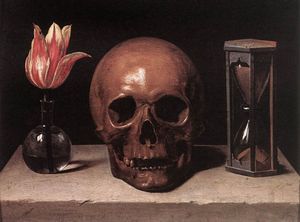
Any conception of mankind's awareness of death in existential philosophy is something like the memento mori [Latin: "Remember you are mortal."] in the realm of art. It became a tradition near the middle of the last millennium to include in portraiture a reminder of the subject's mortality--a less-than-subtle irony given the fact that a portrait is meant to bestow upon its subject a kind of immortality, at least as much as can be embedded in an image fixed upon a canvas. While the portraitee is situated in a time and place inextricably linked to their experience of life (even if idealized), the fact remains that the painting remains, while the subject does not. The "memento" in these works could be anything from a tiny skull on a mantelpiece, to an hourglass similarly placed, to a full-length, dancing representation of Death with his scythe. We can see it today in works ranging from painting to sculpture to literature, and even in song. The message of "Memento mori" forms the basis of festivals such as Carnevale and Mexico's Day of the Dead, Christian celebrations of life in the face of our own collective mortality. New Orleans, home of Carnival in the United States,* is also the home of a sanctified tradition known as the "jazz funeral." Led by a full-deco brass band (and sometimes two or three), the members of a funeral party wend their way through the streets, dancing and singing, waving their handkerchiefs and pumping their parasols in the air in a defiant final party for the deceased.** Man's*** knowledge of death is the genesis, the cornerstone of every great work of art, in whichever medium one might choose. Beethoven's "Ode to Joy" would be simply a minor section of a major work, were it not for the fact that its triumph, its "Joy," lies in Ludwig Van's momentary willingness to ignore our human mortality. Nobody would waste hours in front of Da Vinci's "Mona Lisa," jockeying for position with the hordes of photographic coup-counters, were it not for the fact that her enigmatic smile represents a stay of the inevitable (i.e. death) for both the subject and the observer. And what could explain our continuing fascination with Romeo and Juliet, without their acute recognition of life's temporal insanity and death's omnipresent finality?

And yet these mainstays of the Western tradition are nothing more than what Pascal would term "diversions," though they hold at their core an acute awareness of Man's mortality. Far from being modes of escapism, they express our collective knowledge (albeit anecdotal) of death. Life, however, remains at the fore as we find our expressions in song and dance, in inebriation and excess, in the general enjoyment of our temporary, earthly bodies. What more can we assume to be true? Yes, they are diversions, but in these diversions we find the most relevant, prescient experience of what it means to be alive, to exist. There remains a simultaneous recognition of death and life, an expression of Kierkegaard's "passion" that finds itself not bemoaning the nature of existence but rather embracing it for (and in spite of) its temporality. After all is said and done, the worst, most grievous diversion of all is the belief that any true understanding of life, death and existence can come from theoretical pursuits. These exercises in frivolity and notion can provide us with starting points for debate, with nomenclature and terminology and methods by which we can attempt to put our hands on such elusive, mercurial concepts--but in the end, each of us is given the task of making his own life. The "how" of existence is not something to be figured out as one would a mathematical problem.

In "The Myth of Sisyphus" Albert Camus writes, "There is no fate that cannot be surmounted by scorn." He likens our existential dilemma to the figure from Greek mythology, condemned to an eternity rolling a boulder up a hill only to have it roll back down each time he reaches the top. But Sisyphus understood the absurdity of his fate, and therein, according to Camus, lies his triumph. So, too, must human beings embrace the absurdity of our fate as mortals. What Camus called "scorn," the rest of us can regard as mere acceptance. Regardless of the diversions we seek--be they "dancing, playing the lute, singing, making verses, running at the ring" (from Pascal's "Pensées")--Death waits in the wings as "a possibility in every moment" (per Heidegger). This much is the only given of our existences. Understanding such a momentous truth is our task, one undertaken with all of Kierkegaard's "fear and trembling," but the end result must be one of joy, of passion for each successive, fleeting moment. Our response to "Memento mori" must be "Carpe diem!" To react otherwise would be to cheapen the value of any fear, any trembling, any angst, negating all the good that could come from any of the above. Existence precedes any understanding of it, to paraphrase the Dane. Life, in the end, is in the living of it--and that living is brief. Memento Mori, bitches, and Carpe Diem. Seize the fucking day.

*: Even if Mobile, Alabama claims the first celebration of Mardi Gras in the western hemisphere.
**: The "funeral" part of the term is a misnomer generally agreed upon, as the parades are nothing if not a celebration of life.
***: Please pardon my lack of political correctness. I use "Man" in lieu of "humanity" or another similarly loaded noun purely out of a desire for succinctness. I do not wish to alienate the fifty-one percent of the globe who respond to neither "Man," nor "He."

Friday, April 28, 2006

Friday's Exercise in Randomness

[Some random facts, musings, and assertions for a Friday afternoon:]

Swans mate for life, bears are notoriously bad with names, and a moose will never give you the correct time. Even if he's wearing a watch.

The only proper answer to "Do you have the time?" is "I've got all the time in the world for you, sweet cheeks."

The square root of 169 is 13, but math skills never got anyone laid. Isaac Newton invented calculus and died a virgin.

"E.R." is currently the only narrative on television to deal with the situation in Darfur.

If a tree falls in the forest and nobody hears it, could Manute Bol still use it as a walking stick?

We hold the truth to be self-evident that all men are created equal, but a black man in America only counted as three-fifths of a human being until 1865.

Thinking about baseball and envisioning Margaret Thatcher in B&D gear are the two most effective ways to delay male orgasm.

You can't fake a parade.

The only good elevator ride is a solo elevator ride.

Honestly, who throws his shoe?

Sometimes, no matter how cultured or sophisticated you would like to appear, an unexpected fart will elicit more than its due amount of snickering.

Yawns are contagious, but nobody knows why. My favorite theory is that they are a vestigial growl left over from our days swinging in the trees, and that their contagiousness is now merely an unconscious form of submission to the alpha-primate.

Monkeys fling poo, though I've never seen one yawn.

Nobody flosses three times a day.

Anyone over the age of 22 who watches MTV regularly is trying too hard.

Raiders of the Lost Ark might be the best movie ever.

On that note: Harrison Ford and Mel Gibson can only star in movies that involve threats against their families or wives (respectively), Al Pacino has been screaming instead of acting since his histrionics won him an Oscar for Scent of a Woman, and Robert De Niro needs one more sequel to Meet The Parents before I write him off completely.

Seriously, he's almost dead to me.

More people need to read Jitterbug Perfume, by Tom Robbins.

Hunter Thompson made up most of the drug shit in Fear and Loathing in Las Vegas. Still, it's a better story for it.

Grace Slick planned to bring a vial of LSD and spike the punchbowl during an invite to the Nixon White House. She didn't follow through, but that single act could have saved countless lives and changed the course of history.

I'm out, and I'll catch you all on the flipside. Have a nice weekend.

[After consideration, a brief addendum:]

The most effective means of delaying female orgasm is being the guy who thinks about baseball and/or Maggie Thatcher, with or without said B&D gear.

Newton also dabbled in alchemy and may have suffered from mercury poisoning and Asperger's Syndrome, a mild form of autism. No word on that information's effect on the ladies.

Cats always land on their feet, and toast always lands jelly-side down. I have yet to Smuckers a cat and test both hypotheses.

No matter how many stories up, it's always a kick to spit over the railing.